


KEY FACTS
WHAT HAPPENED? Iran’s strikes on Gulf energy infrastructure have disrupted global oil and gas markets, but Gulf sovereign funds and private investors are pressing ahead with critical minerals investments in Africa
WHY IT MATTERS? With the Gulf accounting for roughly $179 billion in African investments over the past decade, any sustained pullback would reshape how Africa finances its mining sector
WHAT’S NEXT? Expect short-term delays in deal execution as Gulf budgets absorb the oil shock, followed by a surge in infrastructure-for-minerals agreements once the crisis stabilizes
Iran’s strikes on Gulf energy infrastructure have sent shockwaves through the global economy. Crude oil is trading at roughly $100 a barrel, its highest point since the 2022 surge. QatarEnergy, the world’s leading liquefied natural gas (LNG) producer, has temporarily paused production, a move that alone caused UK natural gas prices to jump 40%. Countries such as Sri Lanka have resorted to drastic fuel rationing while European states scramble for new energy sources.
Yet beyond oil, other economic pillars are under being impacted, including Gulf capital outflows. With GCC states generating a current account surplus of over $800 billion, the Gulf monarchies have become major capital providers for economies around the world, and Africa sits near the top of that list.
Africa’s critical minerals landscape has attracted foreign powers from across the globe. Yet while heavyweights such as the US and China dominate the conversation, scant attention is paid to Gulf states, which despite the ongoing conflict, remain intent on keeping their mining-related capital flowing into Africa.
Case in point: Over a week into the Iran crisis, American investment firm Cove Capital and Saudi conglomerate Abdel Hadi Abdullah Al-Qahtani Group of Companies (AHQ) announced a joint multibillion-dollar fund to invest in critical minerals projects across Africa, signaling that the war has done little to deter Gulf appetite for African resources.
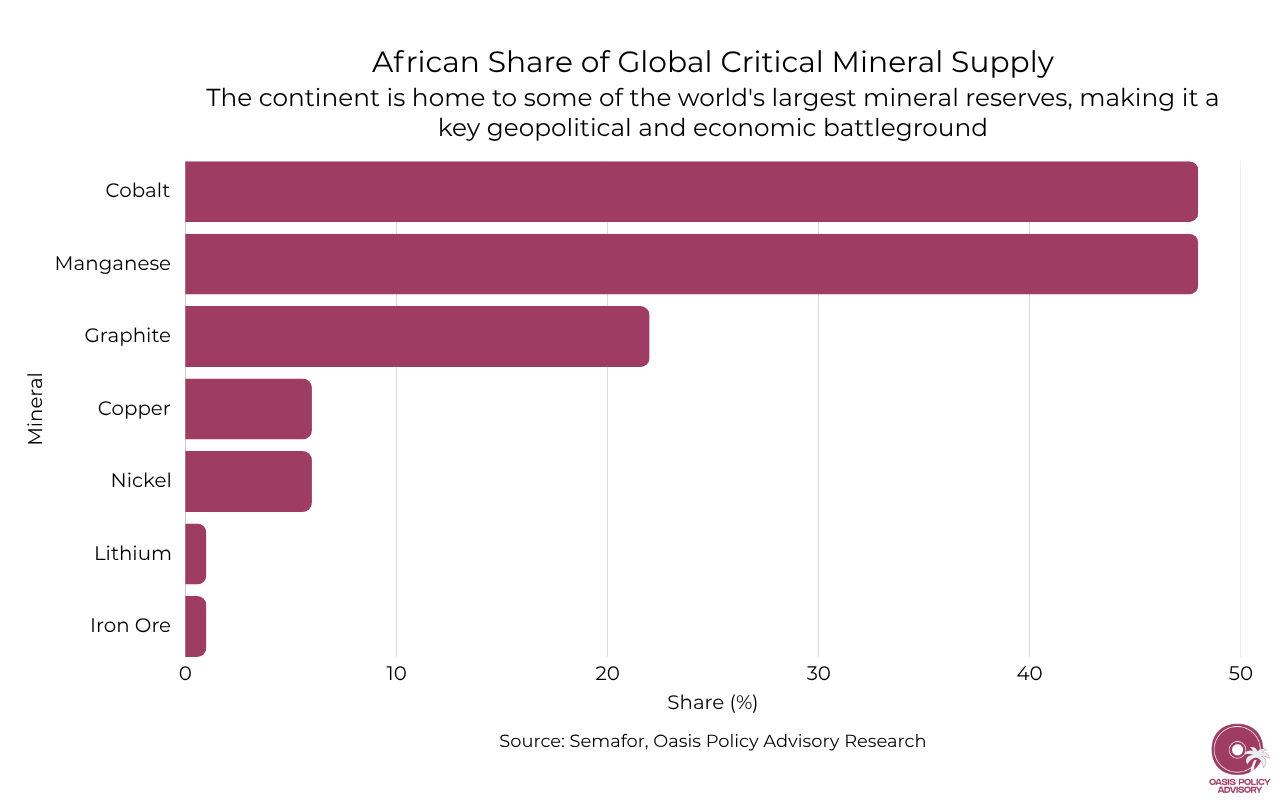
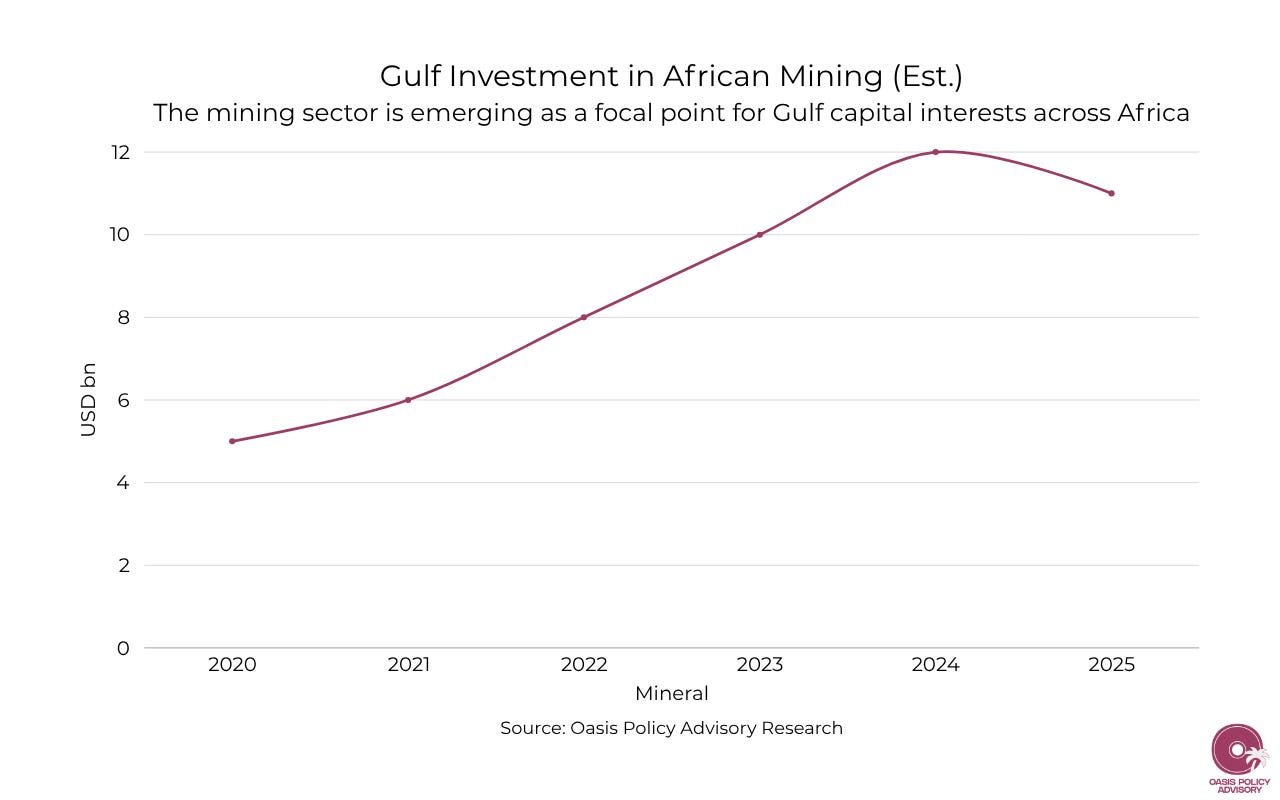
Since 2019, the Gulf—particularly Saudi Arabia and the UAE—has positioned itself as a leading backer of Africa’s capital markets. Gulf investments across Africa reached approximately $179 billion over the past decade, rivaling commitments from larger powers such as the US and UK. While energy and ports lead in volume, mining has emerged as a priority sector, particularly in the contest for critical minerals.
Emirati mining company International Resources Holdings has secured stakes in Zambia’s Mopani Copper Mines. Emirati firm Primera Group signed a $1.9 billion deal with DRC state miner Sakima to rehabilitate four mines focused on tin, tantalum, tungsten, and gold. Saudi Arabia’s Manara Minerals, meanwhile, acquired a 10% stake in Vale Base Metals, which includes African and Brazilian copper and nickel assets; last June, Manara was also reportedly in negotiations for a 15-20% stake in First Quantum’s Zambian operations.
Gold, though not traditionally classified as a critical mineral, has also become a focal point. Dubai has emerged as a key trading and processing hub for African gold exported from countries such as Ghana. Riyadh has entered the fold too, striking a mining agreement with Sudan’s military-backed government to conduct gold exploration along the Red Sea coastline, in spite of the country’s war.
For African partners, the stakes of the Iran crisis extend well beyond energy. GCC fiscal positions remain heavily oil-dependent, with hydrocarbons providing roughly 30-90% of government revenues. Sustained export disruption driven by the Strait of Hormuz closure and now Houthi threats over the Red Sea could translate into tighter budgets and more conservative overseas spending.
Yet despite these pressures, Gulf states are unlikely to retreat easily. Amandeep Kaur Ahuja, Head of Research at Confluence Consultants, argues the Gulf’s Africa strategy was never built for short-term agility.
“The model of Gulf investing in Africa has never been related to aid or loans,” Ahuja said. “The mindset has always been largely of long-term strategy, as opposed to something that can just be changed very quickly based on regional dynamics.”
That long-term orientation is buttressed by structural imperatives that the crisis has only sharpened. China’s near-total dominance of critical minerals supply chains—controlling an estimated 85-90% of global rare earth mine-to-metal refining—makes upstream African equity a strategic imperative in an increasingly multipolar world.
The Gulf is also positioning itself as a serious emerging technology player, particularly in AI, through partnerships with firms such as NVIDIA and Quantinuum. Those ambitions depend on the very minerals concentrated in African soil.
Ahuja also sees the energy transition as an accelerant. “Because we’re seeing so much pressure on oil and conventional sources of energy, I would imagine that the transition to renewable energy would be accelerated and that requires quite a lot of the minerals that are in Africa.”
Most ironically, the Hormuz crisis reinforces rather than undermines the case for hard assets abroad. Gold has long served as a safe haven during periods of market stress, and Gulf policymakers appear to be drawing the same conclusion about upstream mineral equity more broadly.
Capital outflows may stall in the short term; Ahuja expects delays in capital deployment over the next six to twelve months. But a halt is another matter entirely. Once the crisis subsides, expect a surge in infrastructure-for-minerals deals: the Gulf seeking resources, Africa providing them in exchange for strategic infrastructure.
Far from retreating, Gulf states are being pushed to become more strategic. The minerals underpinning the energy transition and the AI revolution are far too important to abandon. And in a strange way, regional insecurity is making the case for African critical minerals stronger, not weaker.
This reporting may be cited with attribution to Oasis Media Collective. For licensing, republication, or extended use, contact here.