


Welcome to the Tuesday note of Oasis Media Collective’s flagship Explainers series, where we provide a breakdown of the most critical yet underreported geopolitical developments and what they mean for the world.
What Happened
On February 4, 2026, Secretary of State Marco Rubio will convene the inaugural Critical Minerals Summit in Washington, D.C. The closed-door diplomatic gathering brings together foreign ministers and senior officials from dozens of countries to establish a coordinated framework for securing and diversifying critical mineral and rare earth supply chains.
At the heart of this gathering: Africa. The Democratic Republic of Congo (DRC) is sending its highest-level delegation, including President Félix Tshisekedi. Senior officials from Guinea and Kenya will also attend.
The summit centers on a draft Framework Agreement on Cooperation on Critical Minerals Sourcing and Processing, which has been circulated to participating governments. The agreement covers the entire supply chain: upstream mining and extraction, midstream refining and processing, and downstream recycling and market governance. Signatory governments commit to mobilizing public and private capital for priority projects, streamlining permitting processes, and coordinating investment to reshape critical minerals markets.
This initiative builds on the Biden administration’s CHIPS and Science Act of August 2022, which allocated $53 billion to strengthen domestic semiconductor manufacturing, including $50 million specifically for Neodymium Iron Boron (NdFeB) magnets used in chips. The Trump administration has continued this trend, particularly with its most recent announcement of a national critical minerals reserve backed by $10 billion in financing under the name “Project Vault,” which Trump declared would be a “global coalition.”
The summit is explicitly framed as a benchmark for how U.S. partners position themselves on critical minerals ahead of President Trump’s planned meeting with Chinese President Xi Jinping in April 2026.
Why It Matters
The race to secure critical mineral supply chains runs directly through Africa. The continent holds approximately 30% of the world’s known critical mineral reserves—including copper, cobalt, lithium, graphite, and manganese—and is projected to produce 10% of global rare earth supply by 2030. The DRC alone produces up to 70% of the world’s cobalt, essential for both batteries and semiconductors.
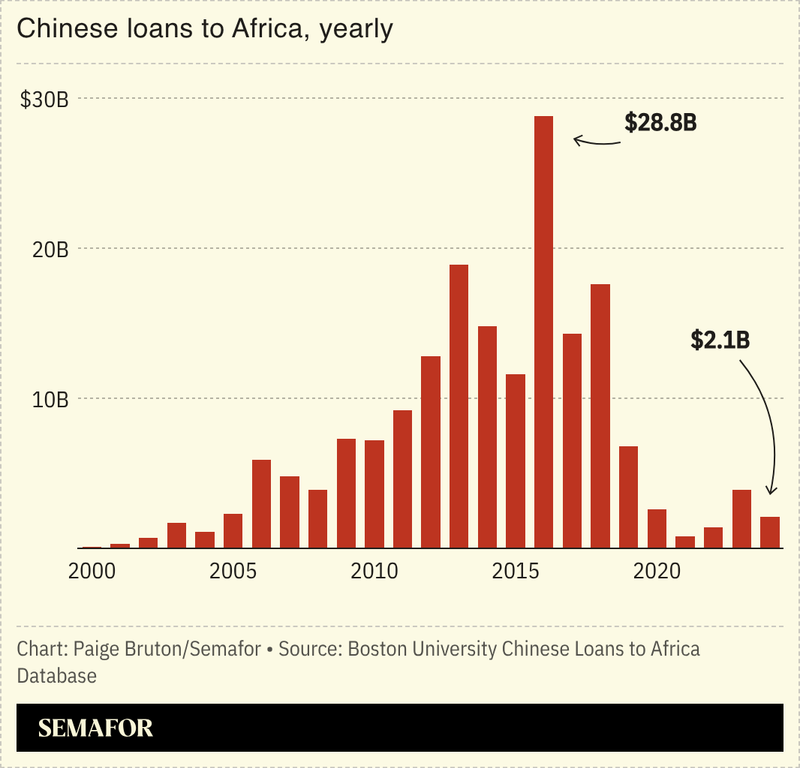
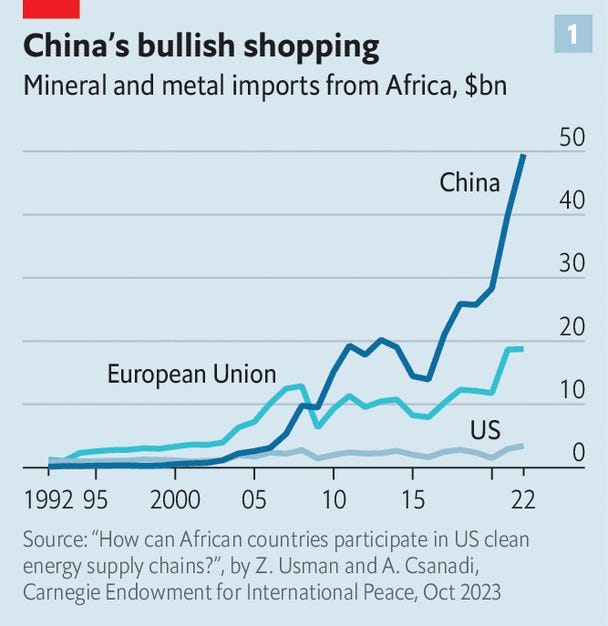
Yet China, not the United States, has dominated Africa’s mining landscape for decades. Between 2000 and 2024, Beijing loaned over $180 billion to African countries, primarily for infrastructure projects. By 2022, China was importing close to $50 billion in minerals and metals from Africa annually, compared to America’s less than $10 billion. Chinese firms control 80% of the DRC’s cobalt output, cementing Beijing’s grip on inputs critical to chips, batteries, and AI systems.
Africa, meanwhile, attracts less than 10% of international exploration spending—and much of what it does receive comes from Chinese firms.
For Washington, this represents both a strategic vulnerability and an opportunity. Critical minerals are essential for semiconductors, and semiconductors are the foundation of artificial intelligence and advanced manufacturing. Reducing dependence on Chinese-controlled supply chains has become a focal point of American foreign policy, particularly as tensions over technology and trade intensify.
The summit also signals a broader shift in U.S. engagement with Africa. With USAID effectively shut down, Washington is pivoting toward a “trade, not aid” mentality, emphasizing private investment and commercial partnerships over traditional development assistance. The Framework Agreement reflects this approach: in exchange for U.S. financing and long-term purchase commitments, signatories are expected to fast-track permitting and commit to concrete project pipelines within six months.
For African governments, the calculus is complex. The summit offers additional American investments, such as last year’s $1.8 billion consortium to invest across supply chains in mineral rich countries, including the DRC. Many African states are also eager to access cutting-edge American technology as they expand their own tech ecosystems.
But the risks are significant. Several of these resource-rich states are engaged in or prone to conflict; the DRC’s war against the M23 is far from finished, despite American peace efforts. Similarly, Kenya finds itself pulled into the new center of geopolitical gravity in the Horn amid escalating tensions between Ethiopia and its neighbors. And there is the diplomatic question: can African states balance the interests of both Washington and Beijing or will they inevitably have to align with one against the other?
What’s Next
With the U.S. continuing its investments in private institutions dedicated to mineral extraction—such as the $1.6 billion commitment to USA Rare Earth—Washington is likely to push more American firms to establish operations across the Sahel and mineral-rich African states. The move comes at a time when Beijing is increasingly drawing back its investments in Africa, creating an opening for the U.S. to expand its footprint.
Despite their close economic partnerships with China, African governments remain open to deepening financial ties with the West. Yet these same states are also unwilling to completely risk their relations with China; Beijing’s presence is too entrenched to ignore, and many African governments are simultaneously pursuing access to Chinese technology from firms like DeepSeek, in parallel to American organizations.
The success of the Framework Agreement will hinge on execution, not declarations. As competition intensifies over key supply chains, African countries are no longer choosing sides, they’re negotiating terms. That shift will shape investment flows, geopolitical alignments, and the future of critical mineral markets over the next decade.
Oasis Media Collective goes where the headlines don’t by reporting on overlooked geopolitical dynamics. Follow for more to receive our deep dive reporting.
Have questions or want to discuss opportunities directly? Connect with us here.