


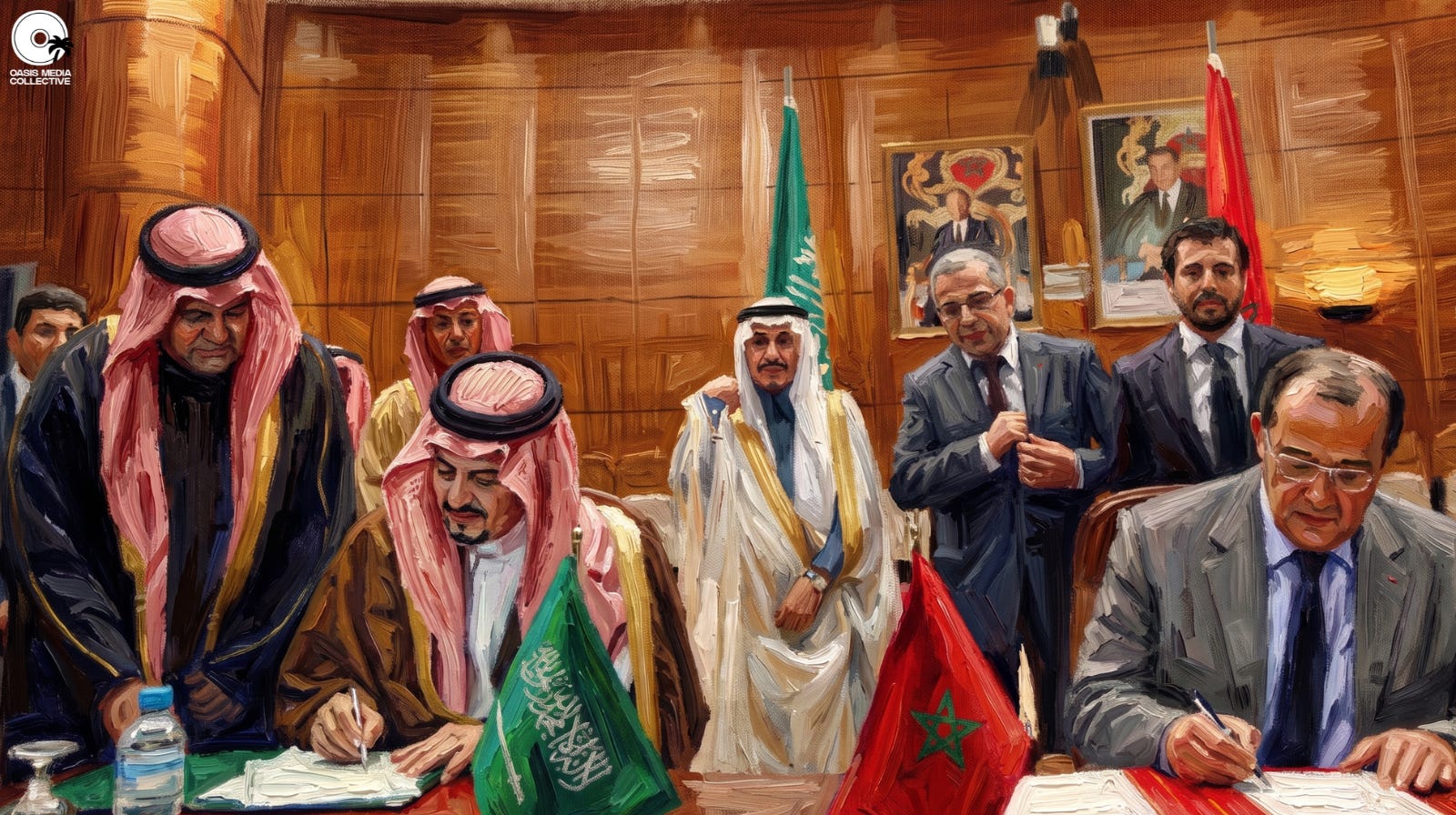
For years, the relationship between Riyadh and Rabat ran on monarchical goodwill and shared positions at the Arab League. That has changed. Since 2023, Saudi capital has moved into Morocco’s power sector at a scale that turns diplomatic friendship into industrial dependency, and the vehicle for that shift is green energy.
In March 2025, Morocco’s government approved six green hydrogen and green ammonia projects worth a combined $32.5 billion under its Offre Maroc (Morocco Offer) framework, a national strategy to cultivate the country’s green energy sector. As part of that March 2025 approval, Saudi utility giant ACWA Power was pre-selected to lead several of the projects launched. By February 2026, that commitment had moved from paper to land: binding agreements allocated up to 30,000 hectares per project out of a one-million-hectare national reserve set aside for the buildout.
Noteworthy is that ACWA Power is far from a small energy player in Saudi dynamics. Owned 44.2% by the country’s sovereign wealth fund, the Public Investment Fund (PIF), ACWA has become a critical conduit for Saudi investments in Morocco. Through ACWA, PIF has become Rabat’s largest foreign private power developer, with a portfolio that includes the four solar plants in Ouarzazate and the Khalladi wind farm under the Noor Solar Complex. These assets were built through Build-Own-Operate-Transfer contracts worth well over $1.5 billion combined.
Why Green Energy?
Morocco’s geographic positioning doesn’t just lend itself to World Cup hosting. Sitting 14 kilometers from Spain across the Strait of Gibraltar, two subsea cables are already carrying 1400 MW from Morocco to the European grid, with a third under construction. Between limited oil supply and driving heatwaves, Europe is increasingly turning to North Africa as an energy lifeline, with Morocco in particular shaping to be the go-to renewable energy provider. Helping to cultivate Rabat’s green energy sector enables Riyadh to bolster its own ties with Europe, even if indirectly.
Renewable energy is nothing more than a dream without phosphate, and by a large margin, Morocco has the world’s highest phosphate reserves. Holding approximately 50 billion metric tons, the North African country accounts for roughly 70% of the global supply.
Morocco hopes to tap into that supply in order to fuel higher production levels, which Saudi Arabia is more than happy to support: Morocco’s phosphate giant, OCP Group, needs vast volumes of green ammonia to decarbonize fertilizer production at Jorf Lasfar. Saudi-backed hydrogen projects lock in that industrial customer before a single molecule is exported, a hedge against the possibility that European offtake deals for green hydrogen prove slower to materialize than hoped.
Converging with Morocco’s own interests are those of Saudi Arabia. Renewable projects live and die on financing costs, and Saudi Arabia’s access to cheap sovereign liquidity—sukuk issuances, syndicated Islamic financing—lowers the cost of building solar and wind in a market that would otherwise pay a steeper risk premium. And as much of the world increasingly turns to green energy as globe energy markets remain volatile, multimillion dollar investments in Morocco’s renewable landscape converts Saudi oil revenue into an insurance policy against declining fossil fuel demand.
Chiefly, none of this is separable from geopolitics. Saudi Arabia has consistently backed Morocco’s autonomy plan for Western Sahara at the UN and Arab League; notably, some of ACWA’s solar capacity sits inside the disputed territory itself, at Laayoune and Boujdour. Capital deployment there functions as a vote of commercial confidence layered on top of diplomatic support.
The Fine Print
The relationship isn’t friction-free. NOORo III, ACWA’s flagship solar tower, sat offline for 14 months after a molten salt tank leak in early 2024, costing an estimated $45-47 million in lost revenue and over $51 million in repairs. Falling photovoltaic (PV) costs—down to $0.03-0.05/kWh versus $0.15-0.18/kWh for older CSP technology—have already pushed Morocco to redesign future tenders around PV-plus-battery storage instead. And the unresolved liquidation of the Saudi-owned SAMIR refinery, dormant since 2015 with over $4.4 billion in defaulted debt, remains a cautionary footnote regulators haven’t forgotten.
Still, the trajectory is clear. What began as royal solidarity has hardened into an energy partnership with real land, real megawatts, and a $32.5 billion pipeline behind it, one where Saudi Arabia isn’t just investing in Morocco’s transition, but underwriting a piece of its own.
Join the collective shaping the future of frontier markets. To partner with Oasis Media Collective, contact here.