


Technologists and venture capitalists have—for now—taken a sigh of relief following news at the end of October that China will roll back its recent export restrictions on rare earth minerals after a new trade agreement with the U.S.
In mid-October, Beijing unveiled new policies restricting the export of rare earths, of which it controls 61% of extraction and 92% of global output. The policy required Beijing’s approval for any use of Chinese rare earths in developing 14-nanometer or smaller semiconductors.
Rare earths underpin virtually every modern technology, from smartphones to solar panels. For global VCs relying on the most advanced chips, China’s move exposed a universal vulnerability. As analyst Cyrus Janssen notes:
“If you’re the Dutch company ASML, building the world’s most advanced lithography machines in Europe, you now need Beijing’s approval. If you are TSMC, building microchips in Taiwan, you now need Beijing’s approval, even if you are Intel or Nvidia and operate inside the United States, well you get the picture. They will now be operating under Beijing’s permission.”
Mirroring this was the brief spat between Taiwan and South Africa over semiconductors. In September, Taipei banned chip exports to Pretoria after South Africa expelled its Taiwanese representatives, reportedly under Chinese pressure.
Both restrictions were short-lived. But together, they illustrate the new rules of the global tech game that VCs and startups risk becoming entangled in: semiconductors and minerals are no longer trading goods; they’re bargaining tools.
Africa’s AI Ascent: A New Frontier for Tech and Capital
Africa is emerging at the intersection of China’s mineral dominance and Taiwan’s semiconductor edge. Projected to produce up to 10% of global rare earth supply by 2030, African states are leveraging their mineral wealth to advance their tech venture landscape:
In 2024, African tech startups raised roughly $2.2 billion in equity, debt, and grants.
The data center market, valued at $1.26 billion in 2024, is projected to hit $3.06 billion by 2030, growing nearly 16% annually.
Countries such as Egypt have unveiled ambitious national AI strategies to become continental tech hubs.
This, combined with its mineral potential, makes the continent an attractive destination for VC investment and global startup expansion. Google, for instance, pledged $37 million to back AI development in Africa.
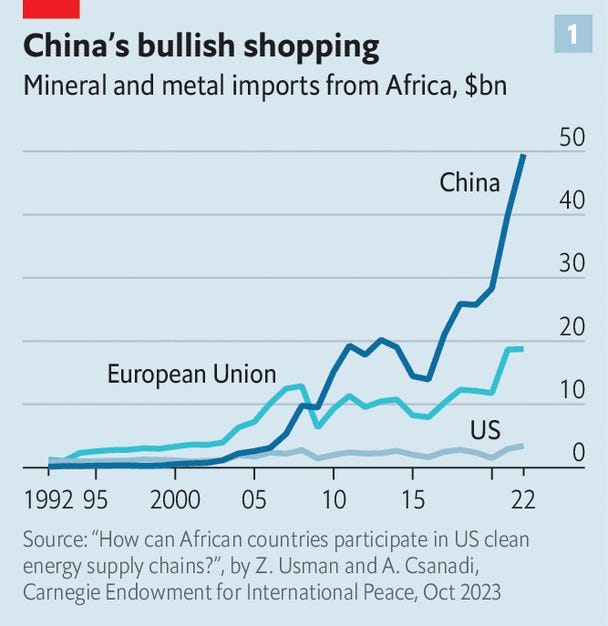
Yet the primary supporters of these initiatives are not in Washington or Silicon Valley, but in Beijing. From Huawei data centers to ZTE broadband networks, China is the main cultivator of Africa’s innovation economies. Egypt’s digital ambitions, for instance, have been heavily supported by Chinese investments. For Western VCs and startups, this limits growth opportunities across the continent.
Further constraining these opportunities is China’s domination of Africa’s mineral landscape. In the Democratic Republic of Congo, Chinese firms control 80% of cobalt output, cementing Beijing’s control of inputs critical to both batteries and chips.
Still, the window is opening for Western innovators to have their own hand in Africa’s burgeoning digital prospects.
Strategic Openings: Where VCs Should Watch
The dispute between Pretoria and Taipei exposes how fragile access to advanced technology can be for the continent. Only one African nation, Eswatini, recognizes Taiwan, while just three—South Africa, Somaliland, and Nigeria—maintain representative offices; relationships that remain vulnerable to Chinese pressure.
Yet as Africans expand their AI ecosystems, engagement with Taiwan is likely inevitable—and, by extension, with the U.S. Washington has demonstrated renewed interest in African infrastructure, signaled by a $550 million loan for the Lobito Corridor and mediation in the DRC–Rwanda peace deal—both aimed at weakening China’s leverage over rare earths and tech supply chains.
As Nathan Schoonover, a research associate for Africa studies at the Council on Foreign Relations, explains:
“Many African countries right now are open to Western investments, specifically from the United States,” Schoonover said.
If U.S.–Africa–Taiwan engagements were to expand, so too would venture opportunities for Western onlookers:
Semiconductor Complementarity: Taiwan’s fabrication expertise paired with Africa’s resource base could enhance localized chip assembly.
Strategic Nodes: Closer Africa–Taiwan ties could open backup manufacturing routes, easing supply chain bottlenecks and reducing exposure to U.S.–China volatility.
U.S.–Africa-Taiwan Connection: If African chip ambitions align with Taiwanese partnerships, Washington’s engagement could expand beyond minerals into high-tech manufacturing and digital infrastructure, creating even more opportunities for international VCs and startups on the continent.
Geopolitical Friction: Risks VCs Can’t Ignore
China will not easily cede its economic leverage, and neither will African states long tied to Beijing so long as the gains remain uncertain. Moreover, China can offer much of what Taiwan can—from AI infrastructure to chip expertise—making competition intense and progress gradual.
“I think there’s hesitancy on behalf of African countries to jeopardize their relationship with China,” Schoonover said. “Though Taiwan is very adept at semiconductor manufacturing and at artificial intelligence, China has those capabilities, as well. Beijing would be just as interested in buttressing that innovation growth for [Africans] as Taipei would be.”
The Next Chapter: Africa’s Tech Non-Alignment Strategy
Still, the long-term trend favors diversification. As Schoonover explains, there are growing concerns among Africans regarding Chinese support.
“[Chinese] firms engage questionably with the African communities in which they operate,” Schoonover said. “There have been reports of child labor, poor working conditions, and underpayment, and there is a broadly understood lack of consideration given to the long-term consequences of environmental degradation, the absence of skills transfer, and other trade-offs that more seriously impact their African counterparts than it does them and their interests.”
As such, African states may, over time, seek to extract value from multiple partners:
China: Infrastructure and manufacturing capacity.
U.S.: Financing and regulatory credibility.
Taiwan: Chipmaking knowledge and technology access.
For Western VCs and tech startups, this means opportunity in facilitation. By advancing the continent’s digital landscape, such stakeholders can create a new corridor for semiconductor and AI development—one more resilient to global shocks and geopolitical competition.