


Last week saw one of the most significant advancements in the Lobito Corridor project. Both the Africa Finance Corporation (AFC) and African Development Bank (ADB) announced a joint investment of $500 million to the railway; AFC also announced plans to launch a new financing effort in the third quarter of this year, with the aim of a financial close in the fourth quarter of 2027.
This would culminate in the project’s completion in 2030. AFC also revealed that it was in talks with at least ten African and foreign financiers to raise an additional $3-5 billion for the project, including with Wall Street’s Citigroup.
At a time when the world needs more cobalt and copper for the energy transition, the stakes of the Lobito Corridor couldn’t be higher. This piece will act as your guide for understanding why that is.
What is the Lobito Corridor?
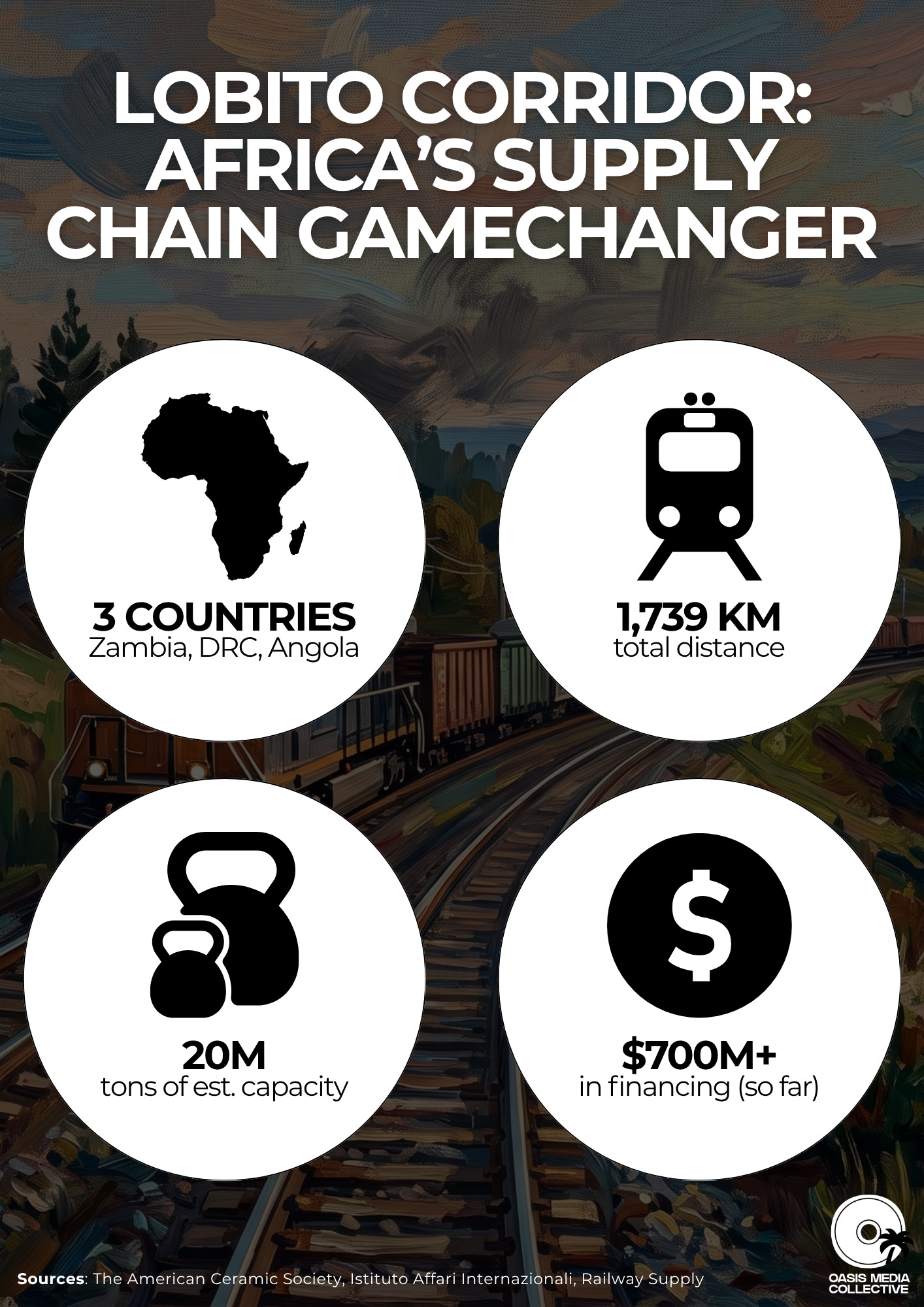
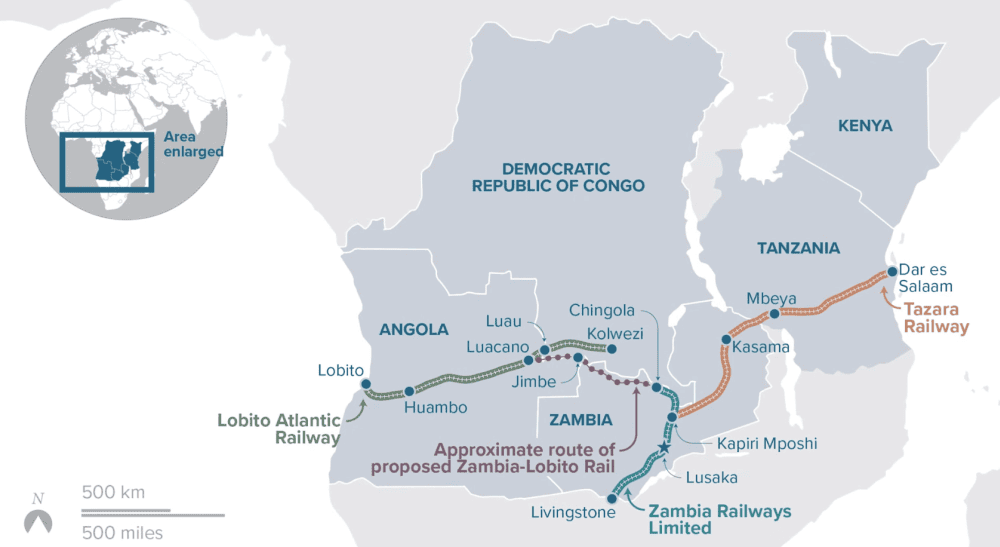
The Lobito Corridor is a railway project that connects the Copperbelt, a 450 kilometer mineral-dense region along the Democratic Republic of the Congo-Zambia border, to the Atlantic Port of Lobito in Angola. The journey traverses through key rail hubs, such as Kolwezi in the DRC, before arriving at Lobito.
Worth $10 billion, the Lobito Corridor will extend across 1,739 km, with a potential capacity of up to 20 million tons.
The project has been one spanning close to a century. The Benguela Railway, the central axis of the Lobito Corridor, was first constructed in Angola in 1931 during the Portuguese colonial period. Following heavy damage sustained during the Angolan Civil War, Benguela underwent rehabilitation lasting until 2014, with repairs costing up to $2 billion.
In 2023, a consortium was formed to oversee the corridor as part of a 30-year concession, investing $455 million in Angola and $100 million in the DRC.
Why is it so important?
The Copperbelt is home to roughly 73% of the world’s cobalt and a major share of its copper, two critical minerals used in both everyday and emerging technologies. Virtually every device you use (including the one you’re reading this piece on) relies on copper and cobalt. The advancement of artificial intelligence and adjacent technologies, such as data centers, is heightening the need for such minerals, demanding greater access that the corridor is designed to deliver.
Speed of trade is also at play. A trial shipment by Ivanhoe Mines in late 2023 demonstrated that copper concentrate could reach Lobito in 8 days, whereas road transport to the Port of Durban in South Africa took 25 days. That speedier transit means lower costs for both exporters and importers, as well as less capital locked in work-in-progress inventory.
The “why” behind the corridor also bleeds into the geopolitical. Beijing has a stranglehold over the mineral supply chains of Africa; in the DRC alone, Chinese firms control 80% of cobalt output, with Beijing’s imports of African minerals and metals having reached approximately $50 billion in 2022–a stark contrast to the EU at just under $20 billion and the US well below $10 billion, according to The Economist.
For Western governments and businesses, the Lobito Corridor is the gateway to wrestling access to African critical minerals away from Beijing. The US International Development Finance Corporation signed a $553 million investment into the project at the end of 2025, while the EU announced it had mobilized €2 billion (~$2.31 billion). European countries have also made individual contributions; Italy invested $320 million in 2024.
Will it deliver?
Exciting announcements and investment packages are one thing, but actual capacity is another.
The Lobito Corridor can currently handle 200,000 tons yearly, a far cry from its stated aim. Furthermore, the Zambia and DRC extensions remain unbuilt; until they are, miners still need trucks to reach the railhead.
If the corridor does live up to its potential, it could handle the entirety of the DRC’s cobalt exports with room to spare. For EV manufacturers, battery producers, and Western governments trying to diversify supply chains away from Chinese-controlled logistics, that’s transformational.
But it also risks creating a new vulnerability: the global energy transition could come to depend significantly on a single rail line in a historically unstable region. As the Iran crisis has demonstrated with oil, heavy reliance on one single node of supply always carries risk.
The Lobito Corridor is both the most credible Western counter-move in the minerals race and a project still years from delivering on its promise. The real test won’t be whether the money is committed, but whether the trains will actually run.
This reporting may be cited with attribution to Oasis Media Collective. For licensing, republication, or extended use, contact here.