


After nearly 60 years, the UAE withdrew from OPEC, the world’s leading oil cartel, on Friday. Since then last week, widespread discussions have been sparked worldwide. As the globe grapples with its largest energy crisis in decades, the UAE’s exit from OPEC was seemingly adding more fuel to the fire of uncertainty.
At a time of confusion and debate in the energy realm, the aim of this article is to distill OPEC and what’s next with the Emirates now out.
What is OPEC?
Formed in 1960 by five countries—Saudi Arabia, Iran, Iraq, Kuwait, and Venezuela—the Organization of the Petroleum Exporting Countries was designed to reclaim control over oil markets and prices from private companies such as BP and Shell, and return it to oil-producing governments. Other countries would later join the organization, such as the UAE in 1967.
OPEC’s market power became evident in 1973, when in the aftermath of the third Arab-Israeli war, Arab member states launched an embargo on Western nations that sent shockwaves through oil prices worldwide.
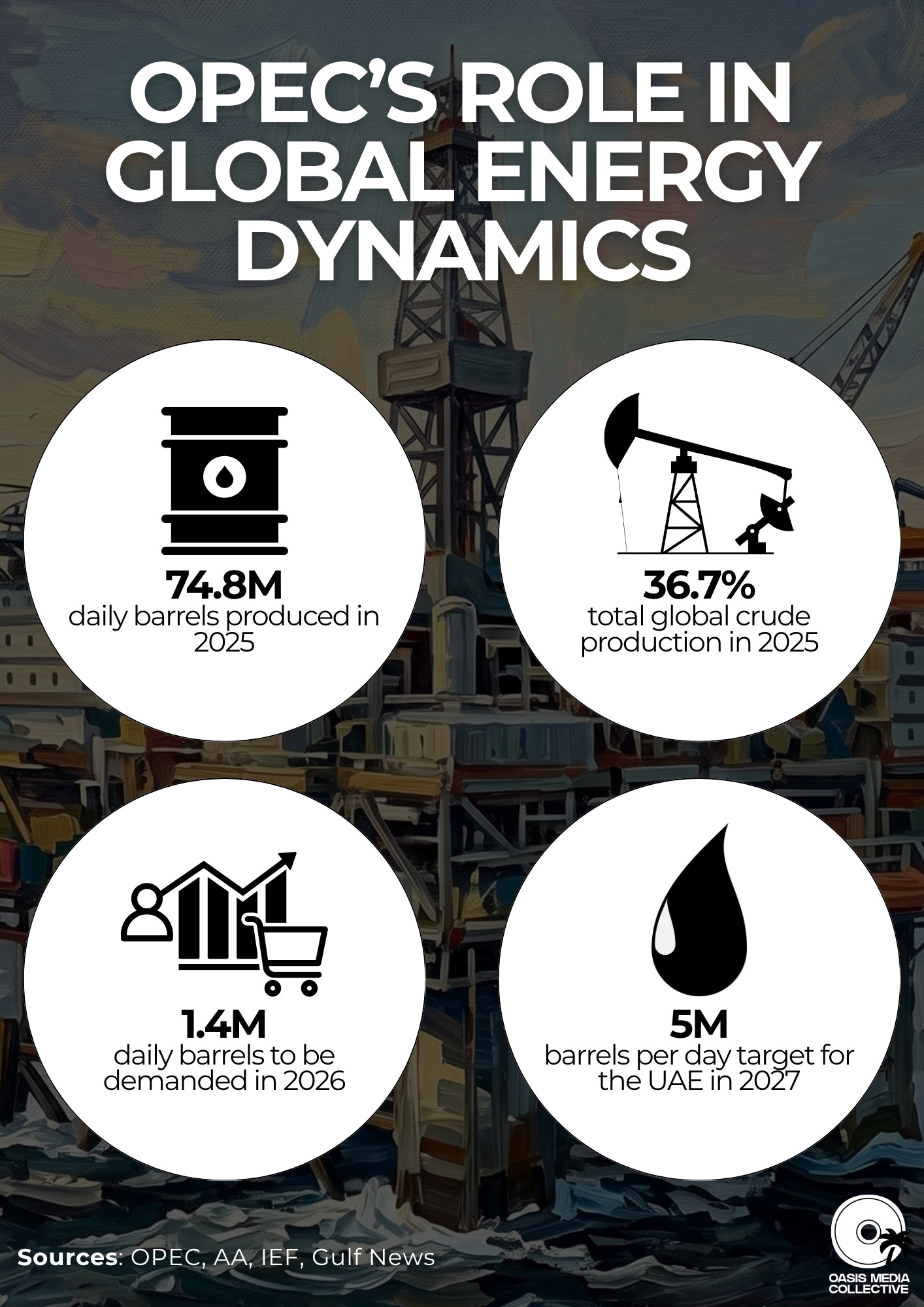
Yet since then, OPEC’s grip over the global oil market has weakened. American companies began experimenting with and introducing new production and extraction techniques in the early 2000s, such as fracking and horizontal drilling. In what became known as the “Shale Revolution,” the US climbed to become the world’s leading producer, with output now sitting at roughly 13.8 million barrels per day (bpd), a figure that barely existed 15 years ago.
The result has been a sustained challenge to OPEC’s market dominance, even with the formation of OPEC+ in 2016, a coalition of 10 non-member allies. A look at the world’s top 15 oil producers includes four non-OPEC members—the US, Canada, China, Norway—while another four are OPEC+ members, just over half the list.
Even some of those included, such as Nigeria and Libya, are still building the infrastructure and trade relations needed to become influential energy exporters. The end result has been a fall in OPEC’s share of global production from its 70% peak in the 1970s to currently roughly 30%, despite the group holding over 80% of the world’s proven reserves.
Why is the UAE leaving?
At a time when the Emirates are diversifying their economy away from oil, Abu Dhabi’s withdrawal is, at its core, an opportunity-cost calculation. With a production capacity of roughly 4.5 million bpd but a quota of just 3 to 3.2 million bpd, the country has been leaving roughly $30 billion in annual revenue on the table, a restraint not felt by non-OPEC members.
That recovered revenue could fund new diversification initiatives, fueling (pun intended) a broader shift away from fossil fuels.
The IEA estimates that OPEC+ holds roughly 5.5 million bpd in spare capacity, 90% of which sits in the Gulf. The UAE’s withdrawal has cut that supply, which as a means of support, Abu Dhabi announced a new production target of 5 million bpd by 2027.
With the UAE’s departure, OPEC’s share of global liquids supply could erode to roughly 27%, down from its current 32%.
By no means does this render the UAE a minor energy player, nor does it make OPEC irrelevant. What it does signal is a shift in the organization’s role: from price setter to price influencer.
What’s Next for OPEC?
What the 1973 crisis taught us—an event observers are revisiting as a potentially even more severe disruption unfolds—is that OPEC’s true power has always been the power of coordinated action. The UAE’s exit chips away at that, leaving a bloc whose market dominance has steadily eroded since its inception.
The numbers haven’t killed OPEC. But they have revealed that as global energy dynamics shift, so too will its role.
This reporting may be cited with attribution to Oasis Media Collective. For licensing, republication, or extended use, contact here.