

Russia Has Beaten the West in West Africa: Elections in the Central African Republic and Guinea Prove It
Recent votes in Central and West Africa show how Moscow’s security-first model is outlasting Western democracy leverage.

Two recent elections in Central Africa and West Africa have quietly cemented a geopolitical reality the West has struggled to reverse.
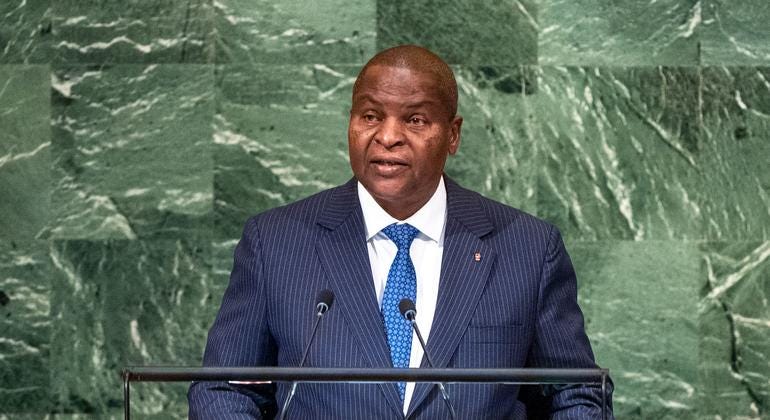
In the Central African Republic (CAR), President Faustin-Archange Touadéra secured a third term with over 76% of the vote after constitutional changes removed term limits. The vote was disputed by opposition groups but upheld by state institutions. Touadéra’s re-election preserves a political order heavily underwritten by Russian security support, which has become central to regime survival.
Meanwhile in Guinea, former coup leader Mamady Doumbouya won nearly 87% of the vote, formally converting a 2021 military takeover into civilian rule under a new constitution. Western governments criticized the process as lacking transparency, but the outcome faced no meaningful external challenge.
Taken together, these results mark not political transitions, but consolidations.
While the West has sought to cement its influence across the Sahel through promoting democratic norms, Russia has taken a security-first approach, dispatching its state-backed mercenary group, the Wagner Forces (now largely rebranded under Russia’s Africa Corps), to ensure regime survival in the face of distress in exchange for resources. And on those terms, Moscow is winning.
In CAR, Russian-linked security forces remain embedded across the country, protecting the capital, securing mining zones, and shielding the presidency from rebel threats. In Guinea—a country that has become critical for Russian weapon supply chains in Africa—Doumbouya’s victory follows a regional pattern in which military rulers gain legitimacy through elections that prioritize order over pluralism, a model Moscow tacitly endorses and Western actors increasingly tolerate.
Crucially, Western leverage has shifted from conditional to rhetorical. Aid suspensions, election monitoring statements, and diplomatic criticism have not altered outcomes, nor have they prevented leaders from entrenching power.
From Mali and Burkina Faso to Guinea and CAR, a new political equilibrium has emerged across large parts of West Africa. Elections are no longer gateways back to Western alignment; rather, they are tools for formalizing military regimes, ones which value security-first partnerships over governance-based engagements. Even as the Wagner Forces pull back from states such as Mali, the underlying demand from African states—regime survival—remains the same.
This is less a Russian surge than a Western retreat. Washington and Paris are no longer willing to expend diplomatic capital, security resources, or economic incentives to contest these outcomes.
Watch next
Whether Guinea deepens security and mining cooperation with Russia as iron ore projects move forward.
Whether CAR’s mineral sector—including gold and uranium—becomes further integrated into Russia-aligned supply chains.
How Western private equity firms may reduce exposure in the face of Russian-targeted sanctions.
How global investors adjust sovereign risk premiums, bond yields, and FX hedges in countries aligning with Moscow’s security-backed governance model.
Russia hasn’t just expanded influence in West Africa—it has helped rewrite the rules of political legitimacy. And for now, the West is playing by them.
For more on the intersection of geopolitical intelligence and venture capital across Africa, follow and share Oasis Media Collective.
Have questions or want to discuss opportunities directly? Connect with us here.