


Throughout the Red Sea crisis, maritime shippers were forced to navigate new routes to reach the Suez Canal. As Egyptian officials concede, no sustainable alternative to the Canal truly exists. While the East African coastline has been marred by insecurity, the North African shores of the Mediterranean Sea have emerged as a viable substitute.
Recent developments, however, show that the Mediterranean is hardly insulated from turbulence.
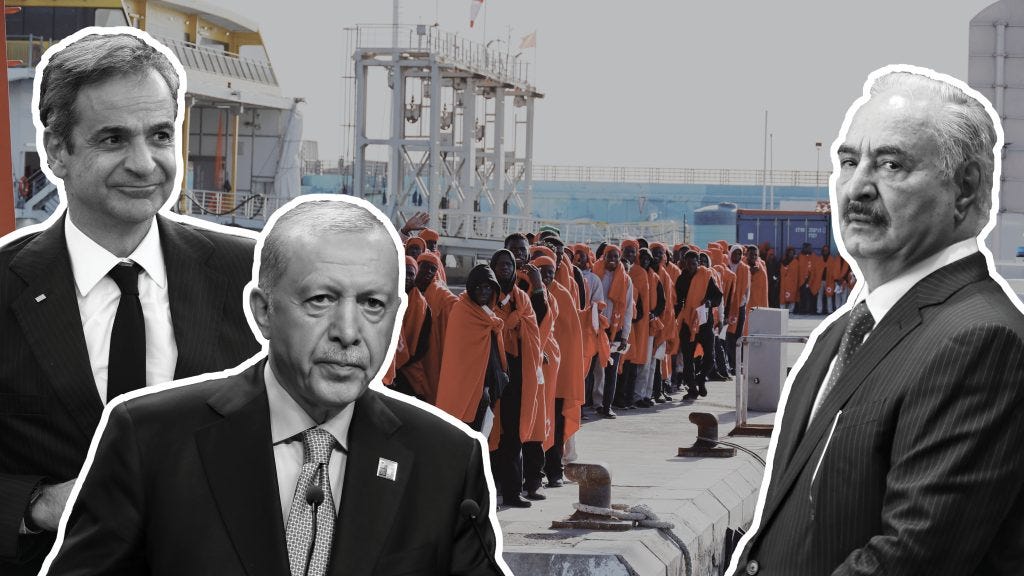
At the end of June, Greece deployed three warships in the Eastern Mediterranean between Turkey and Libya.
According to Greek Prime Minister Kyriakos Mitsotakis, the deployment was a response to a surge in illegal Libyan migration. At a European Union summit, Mitsotakis stated that the vessels would focus on intercepting and turning back smuggling boats bound for Greek waters.
But analysts suggest the move reflects deeper strategic anxieties.
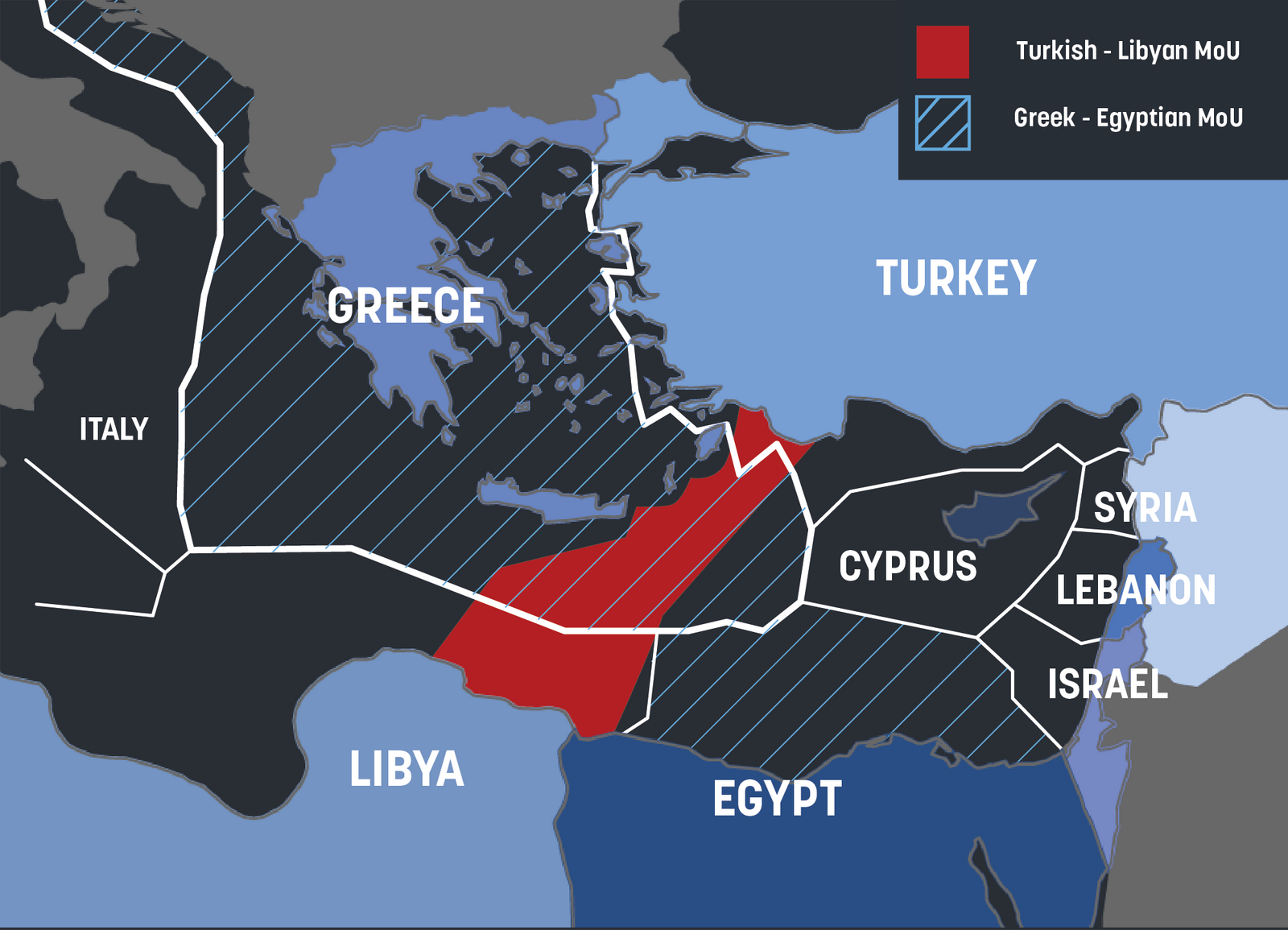
Just a week prior, Libya’s National Oil Corporation signed a memorandum of understanding (MoU) with the Turkish Petroleum Corporation to conduct surveys in four offshore zones along Libya’s coast. The agreement builds upon a controversial 2019 MoU between Tripoli and Ankara that delineated maritime boundaries and established exclusive economic zones (EEZs) for both countries in the Eastern Mediterranean.
That 2019 deal sparked sharp backlash from Greece and Egypt, which argue that it violates the rights of Greek islands, overlaps with their own maritime zones, and breaches the United Nations Convention on the Law of the Sea (UNCLOS). In response, Greece and Egypt signed their own maritime delimitation accord in 2020 and have since coordinated their opposition to the Turkey–Libya alignment.
Five years later, the tensions have resurfaced. Greek Parliament Speaker Nikitas Kaklamanis called for the 2019 MoU to be cancelled, a sentiment echoed by Foreign Minister George Gerapetritis. Libya’s parliament rejected such calls in response, describing them as “interference” in Tripoli’s affairs.
As maritime shippers traverse the Mediterranean and oil companies return to Libya, such developments could ignite a new maritime crisis, one capable of destabilizing the country’s fragile equilibrium.
Critical Waters, Critical Threats
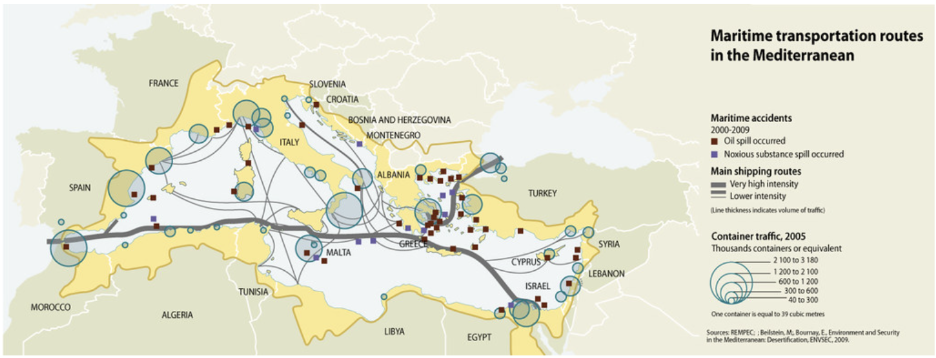
The Mediterranean Sea remains one of the world’s most strategically and economically vital waterways. Its importance rests on five main pillars:
Geopolitical Crossroads: Bordering more than 20 countries, the Mediterranean links Europe, North Africa, and the Middle East, anchored by chokepoints such as the Suez Canal and the Strait of Gibraltar.
Trade and Shipping: Roughly 15% of global sea trade passes through the Mediterranean, including energy exports, industrial goods, and agricultural commodities.
Energy Resources: The Eastern Mediterranean hosts vast offshore gas reserves. Disputes over EEZs have become flashpoints for regional rivalries, particularly between Turkey, Greece, and Egypt. Libya’s position along these contested zones makes it a pivotal actor in this energy chessboard.
Military Projection: NATO, Russia, Turkey, and France all maintain active naval presences. Moscow has even explored shifting assets from Syria to Libya to secure long-term access.
Migration Corridors: The Mediterranean remains a key route for irregular migration from Africa and the Middle East to Europe. Prolonged instability in Libya has made these waters a recurring humanitarian and security flashpoint.
For these reasons, control of the Mediterranean has long been contested by regional and global powers alike, none more assertively than Turkey. Since unveiling its Mavi Vatan (“Blue Homeland”) doctrine in 2006, Ankara has sought to expand its EEZ claims and maritime footprint to transform Turkey into both an energy hub and a naval power. Under President Recep Tayyip Erdoğan, those ambitions have intensified, particularly in Libya, where Turkey backs the Tripoli-based Government of National Unity.
Energy Waters
The Turkey–Libya MoU carries implications far beyond maritime boundaries, as it potentially reshapes the region’s energy calculus.
With the ninth-largest oil reserves in the world and the largest in Africa, Libya’s resource wealth has long attracted energy giants. After being locked out during years of civil conflict, international oil companies are eager to exploit the country’s untapped fields.
European states—reconfiguring their energy strategies amid Red Sea disruptions and Russian sanctions—are also increasingly viewing the Mediterranean as both a supply source and a chokepoint. This shift has amplified Libya’s strategic importance for the EU, represented by Greece in the ongoing dispute.
Turkey’s offshore exploration ambitions put it in direct competition with Greek consortiums tied to major energy firms. For Libya, Turkish partnership offers both political protection and much-needed investment, but risks alienating European backers who favor a multilateral approach.
If tensions escalate into restricted zones or naval confrontations, offshore surveys, LNG supply chains, and port operations could face suspension. For investors and energy traders, these risks are no longer distant; they are near-term operational realities.
A Mediterranean Calamity on the Horizon?
The instability that engulfed the Red Sea has underscored how maritime risks can no longer be dismissed, both by those who traverse the seas or those who profit from them. The Mediterranean’s role as a trade and energy artery will likely increase alongside consumer demand, yet that same importance makes it progressively volatile.
If the dispute between Libya, Turkey, and Greece deepens, particularly through contested EEZs or naval encounters, the region could slide into a maritime crisis with global repercussions. Diplomats, policymakers, and maritime actors must engage now—or risk a future where one of the world’s most critical waterways becomes a battleground.
For more on the intersection of geopolitics and venture capital across Africa, share and follow Oasis Media Collective (OMC).