



KEY QUESTIONS
WHAT HAPPENED? France’s economy narrowly avoided a recession last quarter as slow growth and high borrowing costs rock Paris.
WHY IT MATTERS? France is the eurozone's second-largest economy, and its debt market sets a pricing benchmark for the entire continent.
WHAT’S NEXT? A make-or-break 2027 budget fight looms, set against the backdrop of a presidential election where no party wants to own painful cuts.
For much of the 2010s, Greece was the red flag keeping economists up at night.
Rocked by the 2008 recession, Athens’ GDP plunged by roughly 25% during the peak of the crisis, debt-to-GDP hit a high of 180%, and unemployment soared to nearly 28% in 2013. Greece even became the first (and only) developed market to be downgraded to emerging market status.
Now, people are wondering if France will be the second.
France is being eyed as the “weak link” in European markets, according to Rohan Khanna, head of European rates strategy at Barclays, in an interview with the Financial Times. Khanna added that Paris is now a “perfect storm” given a blend of risks spanning growth, politics, and public finances.
It’s leaving many wondering: is France the next Greece?
The Red Flags in Paris
Going into 2026, the government under Prime Minister Sébastien Lecornu expected a year of stability and even modest growth. Instead:
Deficit is ballooning, currently at 5.4% of GDP despite the target of 5%.
Debt has reached its highest point since 1978, currently sitting at 119.3% of GDP.
GDP growth fell below the government’s 0.7% forecast.
The economy shrank by nearly 0.2% in the first quarter of 2026.
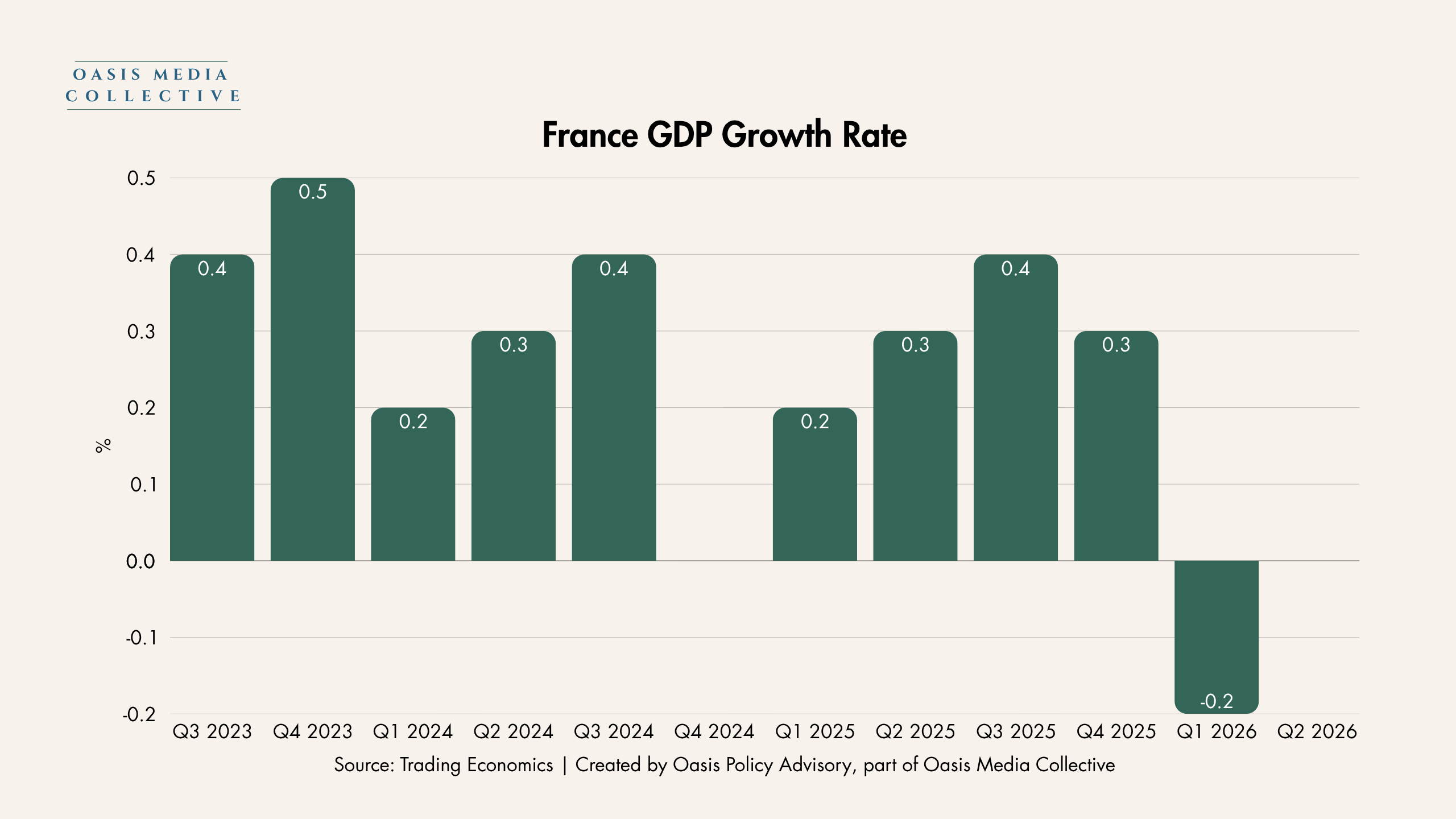
A report from Yahoo Finance noted that the country narrowly avoided a recession last quarter, a close call analysts are treating as a warning sign. Scope Ratings, Europe’s largest credit rating agency, just dropped France’s credit rating—the government equivalent of a credit score—from AA- to A+; similarly, Morningstar DBRS shifted its outlook on France’s economy from “stable” to “negative.” Both cited growing debt and political division as key reasons.
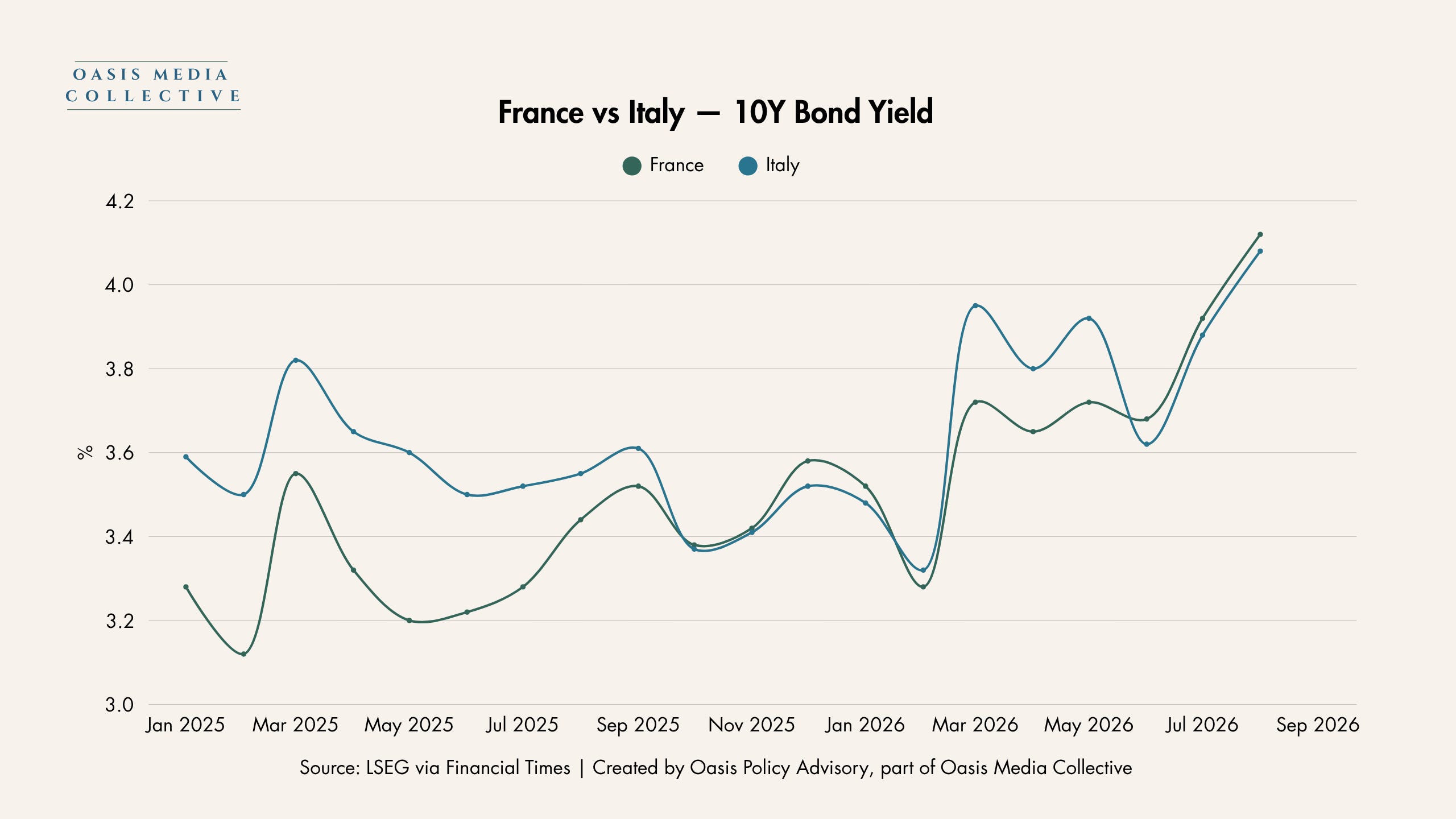
France is now even being compared to some of Europe’s worst-performing markets. For years, Italy was seen as one of the riskiest borrowers in Europe, given that its bond yields were among the highest on the continent. That’s beginning to change, as Italy’s bond yields have cooled while France’s have risen. Even Japan, once one of the biggest holders of French debt, is dumping it at record speed.
How France Got Here
Cracks in the French economy first appeared in 2025, when the government under then-Prime Minister François Bayrou faced weak parliamentary support and deep political divisions, a combination that began to heighten investor concern.
The turning point came earlier this year, when Prime Minister Sébastien Lecornu forced the delayed 2026 budget into law despite political pushback. Now, Lecornu has abandoned his original 5% deficit assumption, stating that it’s “no longer an option.”
The rising tide of uncertainty among French policymakers is spreading to investors worldwide, who no longer view France as the stable bet it once was.
Why the Real Economy Is Feeling It
The back-and-forth in parliament is rippling out into the wider economy. Unemployment is projected to be ticking up toward 8.6% by the end of this year, while business failures are up 5.1% year-over-year, hitting services and hospitality the hardest.
The culmination of it all is businesses closing in record numbers and waves of mass layoffs. All of this is likely to fuel the growing fire of political anger across the country.
France is one of several nations that have seen growing unrest and outrage over rising fuel prices. Fishermen blockaded major fuel facilities and ports in southern France, culminating in clashes with local police. More episodes of outrage are likely to follow if the country’s economic downward spiral continues.
Why the Rest of Europe Is Watching Closely
As the eurozone’s second-largest economy, France’s economic performance is treated as a benchmark for the rest of the EU. Many of the factors rocking Paris right now can be seen elsewhere across Spain, Portugal, and beyond.
So global investors are watching to see if France, “too big to fail,” will be a preview of what’s next for the rest of the continent.
So, Is It Really the Next Greece?
While Paris’ troubles are deepening, France is unlikely to fall into the same crisis Greece did, particularly given that Athens’s collapse was triggered by the wider global economic crash of the late 2000s.
The real danger is a slow, gradual decline, one that plants the seeds of political frustration and unrest over time.
TL;DR: France’s deficit and debt have blown past targets, credit ratings are getting cut, and bond yields just hit their highest point since 2008. It’s not Greece 2.0, but red flags could mean the slow bleed shows no signs of stopping.
Join the Collective decoding markets, policy, and power for the investors of today and tomorrow.
To partner with Oasis Media Collective, contact here.