

Could This African Country Become the Next Oil Power Over Venezuela?
As Venezuela falters, one North African state is quietly positioning itself as the globe's next energy giant.


Three things in life are certain: death, taxes, and oil market volatility from geopolitics. The ongoing Venezuelan crisis—in which longtime President Nicolás Maduro was captured by American forces—is emblematic of all three inevitabilities. According to the Guardian, at least 40 deaths occurred during the Saturday operation. A report from the Washington Journal detailed a fall in oil prices because of the ongoing affair; Brent crude was down 0.8% at $60.28 a barrel, while West Texas Intermediate trading was also down 0.8% at $56.87 a barrel. With that comes new tax burdens for the global oil system, stretching from Latin America to the Middle East.
For investors, energy giants, and onlookers, the events surrounding the U.S. and Venezuela can at best result in short-term disruption to at worst become an international market calamity. A report from Argaam states that in such a drastic scenario, an investment totaling $58 million over a decade would be needed to rebuild Venezuela’s oil production to its historical peak of roughly 3.5 million barrels per day in the 1970s. Other estimates suggest it could be up to $100 billion. And of course, such injections will be contingent on investor confidence, which given the ongoing shockwaves, is unlikely to settle.
Yet even amid this fog of statecraft, one shift is becoming increasingly clear. Thousands of miles away, on the tip of North Africa, lies another oil mecca that has emerged as a serious alternative supplier in a suddenly fractured oil order.
As giants and investors brace for a market vertigo, can Libya be the calming factor to their worries?
A Supply Gap the World Didn’t Plan For
With close to 300,000 billion barrels of oil, Venezuela ranks number one in the world for oil reserves. Caracas’ sovereign jewel has long been mired by energy giants, yet such ambitions have for decades been nothing more than a far off dream for most. Relations between Venezuela and the U.S. have long been turbulent since the 1990s, given Caracas’ socialist governance and close relations to traditional American rivals such as Iran. With Maduro’s capture and the U.S. set to “run the country” according to the administration, private and public powers alike may finally be hopeful that the holy grail of all things energy can be tapped into.
Yet, as the aforementioned Argaam report noted, anybody hoping to build up shop in Venezuela immediately and prosper from day one is in for a rude awakening. Venezuelan Vice President Delcy Rodriguez, now sworn in as interim president, has lambasted the U.S., calling the seizure of Maduro as a “brutal aggression” and demanded his release. Given her dual role as the country’s oil minister, it’s unlikely we’ll see American companies—from big giants to startups—setup shop in Venezuelan soil anytime soon.
“We call on the peoples of the great homeland to remain united because what was done to Venezuela can be done to anyone. That brutal use of force to bend the will of the people can be carried out against any country.” — Rodriguez in a televised broadcast.
If Venezuela is suddenly untouchable, who else will fill the gap—and at what cost?
Africa’s Oil Mecca
Across the Atlantic lies another oil-rich state. Hosting roughly 48 billion barrels, Libya ranks ninth in the world for oil reserves, holding roughly 3% of the total global share. While a decade of war left its oil industry crumbled in the 2010s, the 2020s has seen an ambitious push by Tripoli to revitalize its energy sector.
Production has climbed back above 1.2 million barrels per day, its strongest performance in over a decade, while exports have recovered to comparable levels. Libya’s National Oil Corporation has also set public targets to increase production to 1.6 million bpd by 2026 and 1.8 million by 2027, with a long-term vision of 2 million bpd production. European buyers are already absorbing much of this output.
Recent re-entry by Western majors such as BP and Shell, through exploration and redevelopment agreements, signals a renewed confidence that Libya’s oil sector can function even amid instability, both within and outside of its borders.
Crucially, Libya’s crude grades are lighter than Venezuela’s, cheaper to refine, and geographically advantaged via the Mediterranean—creating a bridge uniting African, European, and Middle Eastern markets, providing far greater versatility than Venezuela or other Latin American states. The end result would be Tripoli’s reassertion as a prominent regional player, after its role was sidelined as a result of the war.
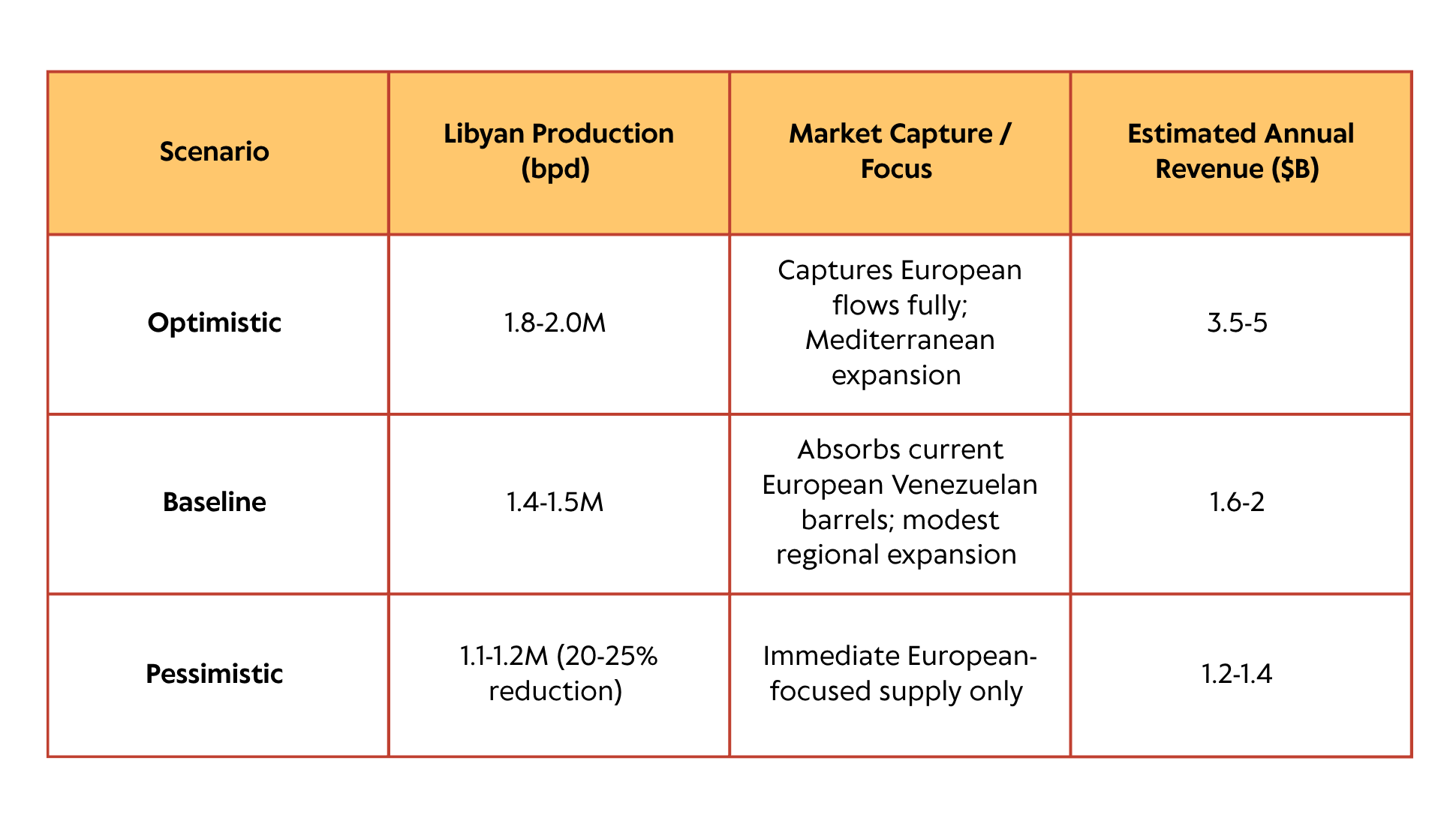
If Libya reaches its stated production target of 1.6 million barrels per day by 2026, European refiners could absorb the majority of Venezuelan crude that flowed into the continent in 2024, at 75,000 bpd. In revenue terms, this translates to approximately $1.6-1.8 billion annually, assuming an average Brent price of $60-65 per barrel. While still smaller than headline global reserve figures, these barrels are strategically concentrated, giving investors direct access to high-margin, crisis-sensitive supply in a market scrambling for alternatives. Scenario analysis highlights the risk-reward tradeoff:
Geopolitics by Substitution
Of course, Libya remains far from a perfect replacement for Venezuela. Not only does Caracas’ reserves outpace Tripoli’s, but the North African state remains far from stable. Continued political divisions and a growing maritime dispute along its northern flank weaken its overall viability. Simply put, Libya isn’t stable; it’s predictable. And in a world of unpredictable crises, that counts for something.
As the world and its oil markets barrel toward a potential geopolitical calamity between the U.S. and Latin America, the time may be now for others to assert themselves on the global stage. From political journalists to market analysts, a common sentiment is being echoed amid the ongoing crisis: the American empire seems to be one in decline, as the world inches toward multipolarity.
If the curtain is truly setting on Washington, will other powers—including Libya—rise to the occasion, both politically and economically?
For more on the intersection of geopolitical intelligence and venture capital across Africa, follow and share Oasis Media Collective.
Have questions or want to discuss opportunities directly? Connect with us here.