

Analysis | How Algeria and Morocco's Military Rivalry Became a Great Power Battleground
Oasis Media Collective | Analysis Wire | February 18, 2026

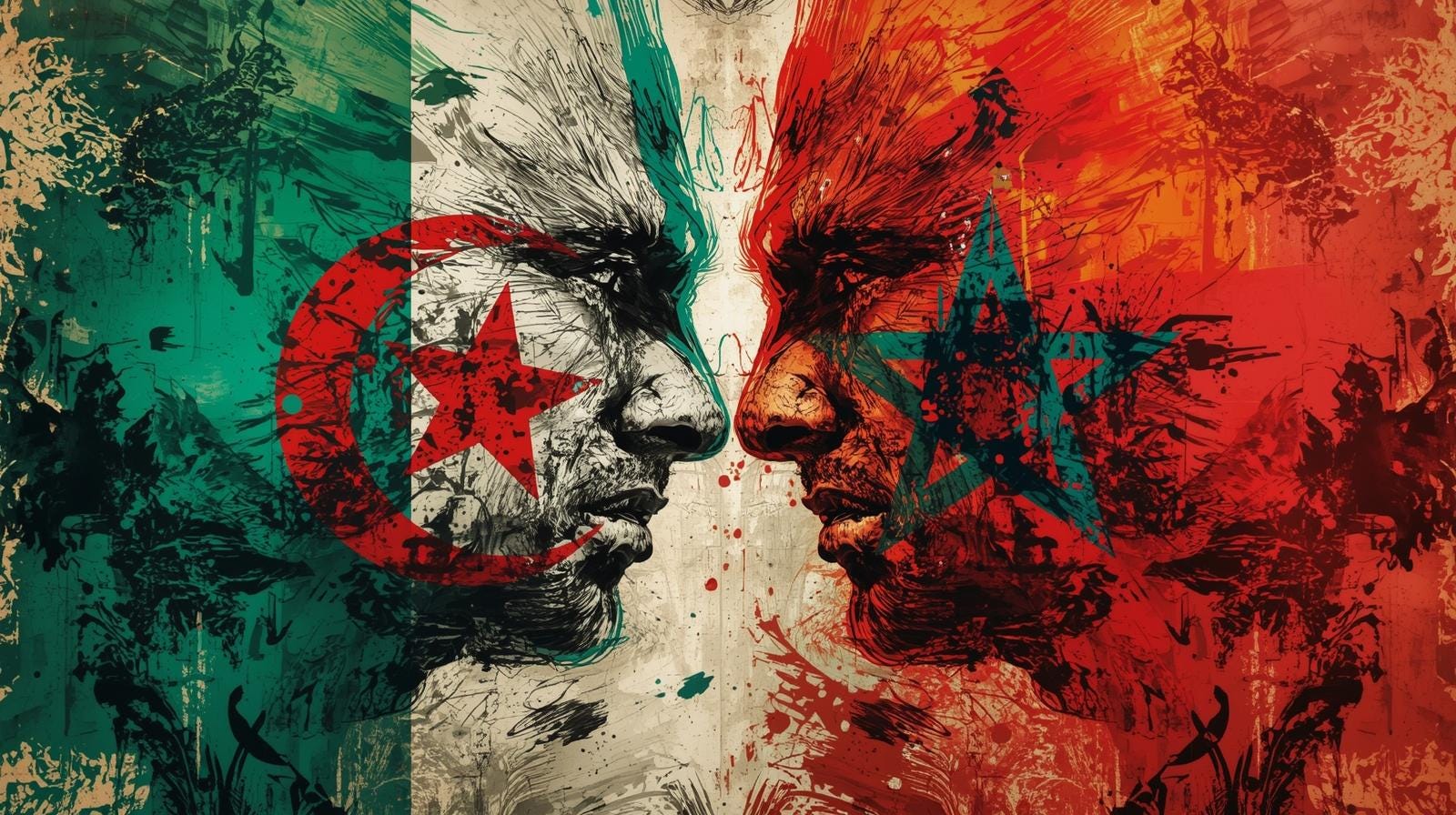
Across the desert dunes of the Maghreb, two countries—Algeria and Morocco— navigate a rising competition. Their enduring dispute over Western Sahara seems to be entering a new chapter; recent peace talks between Algiers and Rabat, the first since 2019 and facilitated by the US and UN, have rekindled cautious optimism that decades of hostility may finally cease. As diplomacy resumes, it’s the preceding chapters—written in defense budgets and alliance structures—that will shape what follows.
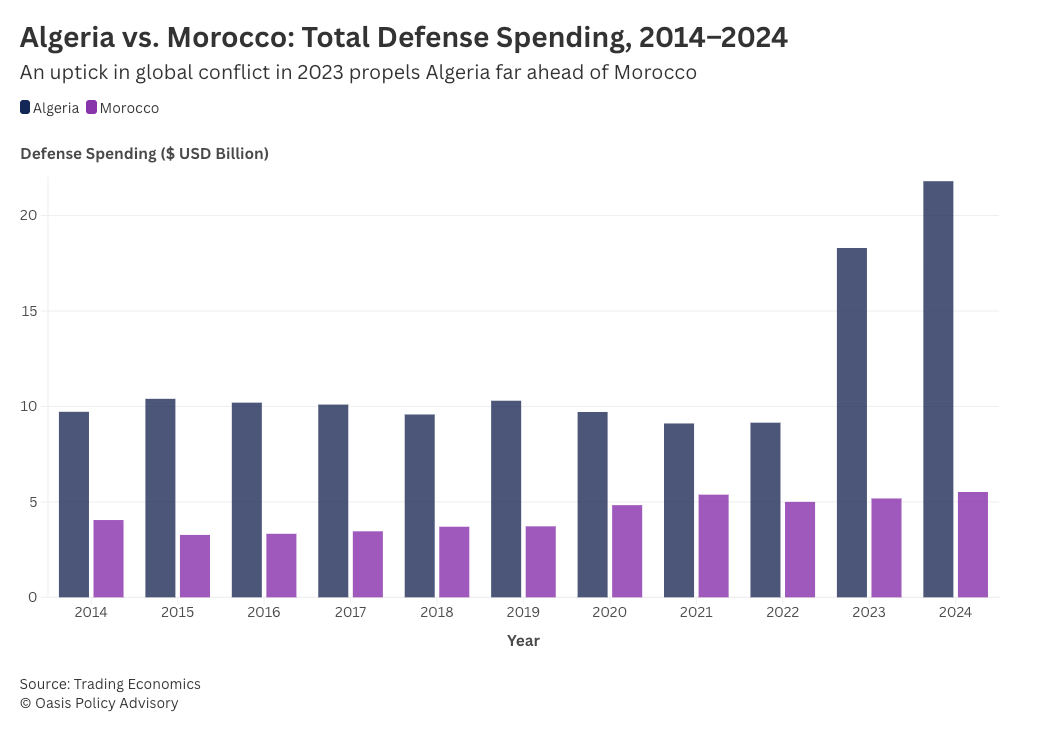
In 2020, when the Western Sahara ceasefire collapsed, Algeria allocated $9.11 billion to defense compared to Morocco’s $5.38 billion. By 2024, Algerian spending had exploded to $21.8 billion, nearly 8% of GDP, while Morocco held steady at $5.52 billion. The spending ratio, once relatively balanced, now stands at nearly 4:1.
But spending reveals only part of the picture. Morocco’s steady defense investments mask deepening military integration with the West. The US and France supply cutting-edge aerial technology, while normalization with Israel has advanced to joint defense systems development, per a military agreement signed this January. Meanwhile, unconfirmed reports emerge of Algeria acquiring Russian Su-57 stealth fighters, deepening its Eastern orientation.
While the hope of peace rises, so too does the specter of sustained tension—a story told not in diplomatic communiqués but in the divergent strategies driving North Africa’s most enduring rivalry.
Geography as Destiny
The 2020s have been transformative for Algerian military investment. From 2014 to 2024, Algiers poured $128.37 billion into defense, nearly triple Morocco’s $47.44 billion over the same period. The most striking figure: a 100.88% year-over-year spending increase in 2023 alone.
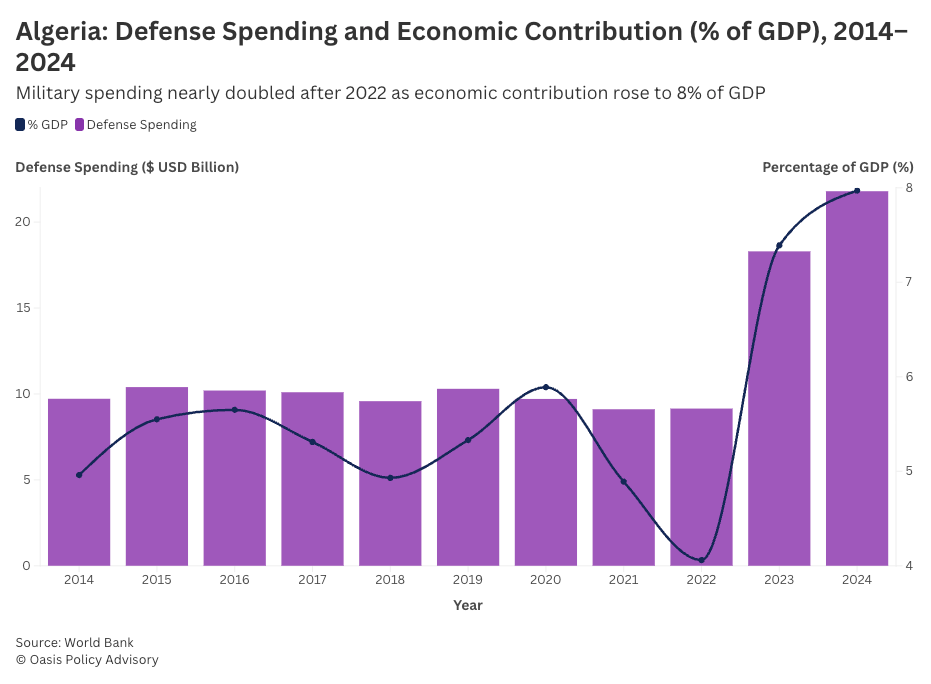
What’s driving this surge? Consider Algeria’s geography: to the west, the Western Sahara dispute; to the east, chaotic Libya; to the south, insurgencies in Mali and Niger threatening spillover. When Algeria shot down a Malian drone last April, it revealed just how fragile its borders have become, translating into strengthening of its military apparatus.
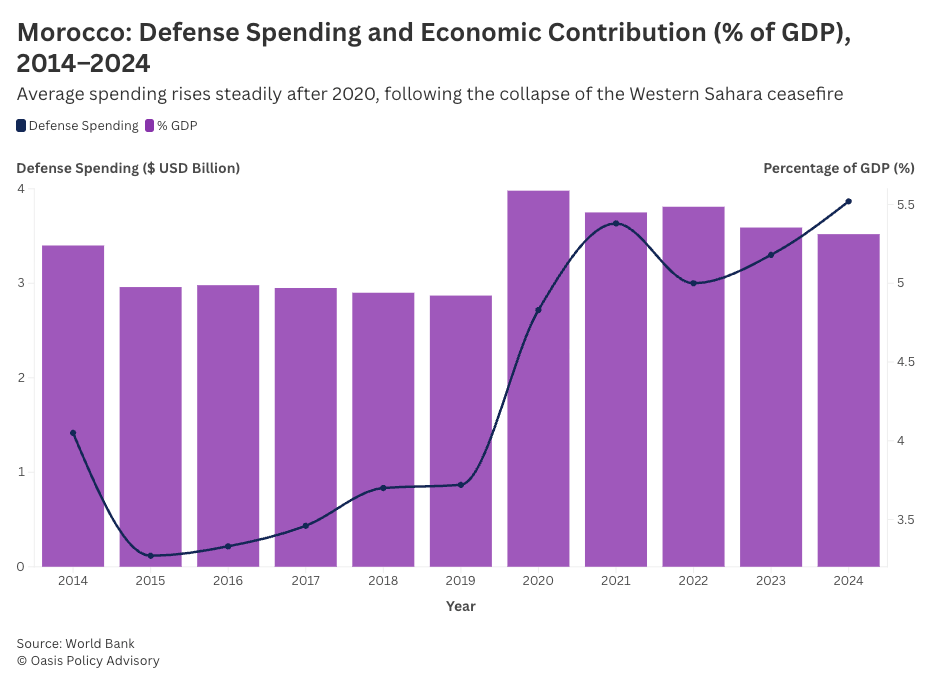
While Rabat did boost spending following the 2020 ceasefire collapse—jumping from $4.83 billion to $5.38 billion in 2021, a 44% baseline increase—its investment philosophy emphasizes controlled growth over shock spending.
Again, geography explains much of this divergence. Morocco faces fewer immediate threats along its borders, allowing for measured, long-term procurement cycles. Even at its 2024 peak, defense spending represented just 3.52% of GDP, less than half Algeria’s proportion.
The year 2022 proved pivotal for both nations, though for reasons beyond their rivalry. Russia’s invasion of Ukraine sent global energy prices soaring and pushed European powers to court North African gas suppliers. Both Morocco and Algeria suddenly found themselves with greater geopolitical leverage, and with it, greater reason to maintain military readiness as international competition for influence intensified.
The result isn’t a traditional arms race, but something more complex: two countries with radically different threat perceptions and spending philosophies, each carefully watching the other’s moves.
Eastern Guns vs Western Systems
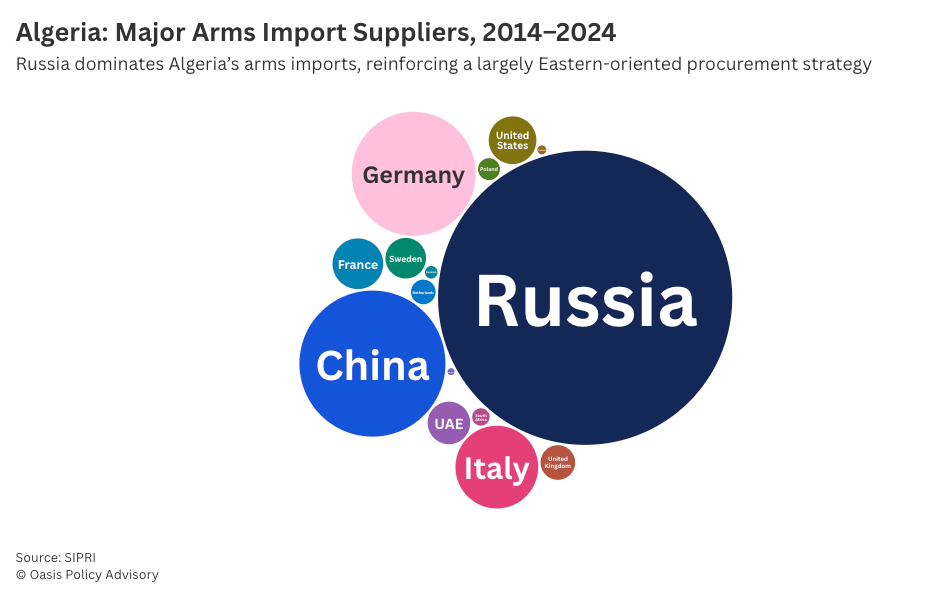
Perhaps more revealing than spending levels are procurement patterns. Algeria’s military remains overwhelmingly oriented toward Eastern suppliers: 61% of arms imports come from Russia, another 15% from China. Approximately 413 of Algeria’s active aircraft originated from the Soviet Union, a legacy relationship that Moscow continues to cultivate with advanced systems like the Su-57.
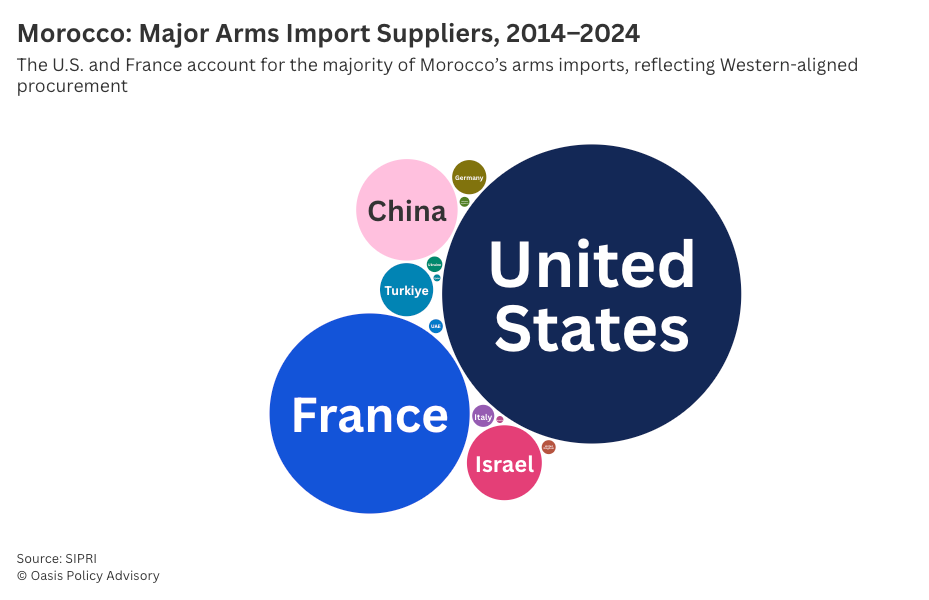
Morocco, by contrast, has built its defense architecture firmly within the Western orbit. The United States supplies 59% of its arms imports, France another 26%. Both countries dominate Morocco’s aircraft weaponry pipeline. Israel has likewise emerged as a growing important partner, providing 3.7% of Moroccan arms imports. At least 51% of Rabat’s defense missiles now come from Israeli sources, according to DW.
For Algeria, which maintains no diplomatic relations with Israel and vocally opposes its policies, Morocco’s deepening military ties with Israel represent yet another wedge in an already fractured relationship. While unlikely to deter the ongoing peace talks, it nonetheless remains a deep sticking point intensifying the Western Sahara dispute.
The Road Ahead
The great powers are positioning themselves. Russia deepens its partnership with Algeria, maintaining a foothold on Europe’s Mediterranean periphery. France reinforces Morocco, preserving historical ties with a strategically located ally. China expands infrastructure investments across both nations. The US prioritizes access to critical minerals. The EU recalibrates its Africa policy from development aid toward economic partnerships.
Whether the current peace talks succeed or fail, the Algeria-Morocco rivalry has already transcended its regional origins. The 4:1 spending gap, the divergent alliance structures, and the competing procurement philosophies represent more than a bilateral dispute; they reflect two fundamentally different visions of security and global alignment playing out in a region that matters increasingly to great powers.
The Western Sahara question may find resolution at the negotiating table. But the larger strategic competition it has catalyzed—over energy routes, military posture, and spheres of influence—will persist regardless. In that sense, the peace talks themselves may be less significant than the defense trajectories that will continue after diplomats leave the room.
This reporting may be cited with attribution to Oasis Media Collective. For licensing, republication, or extended use, contact here.