


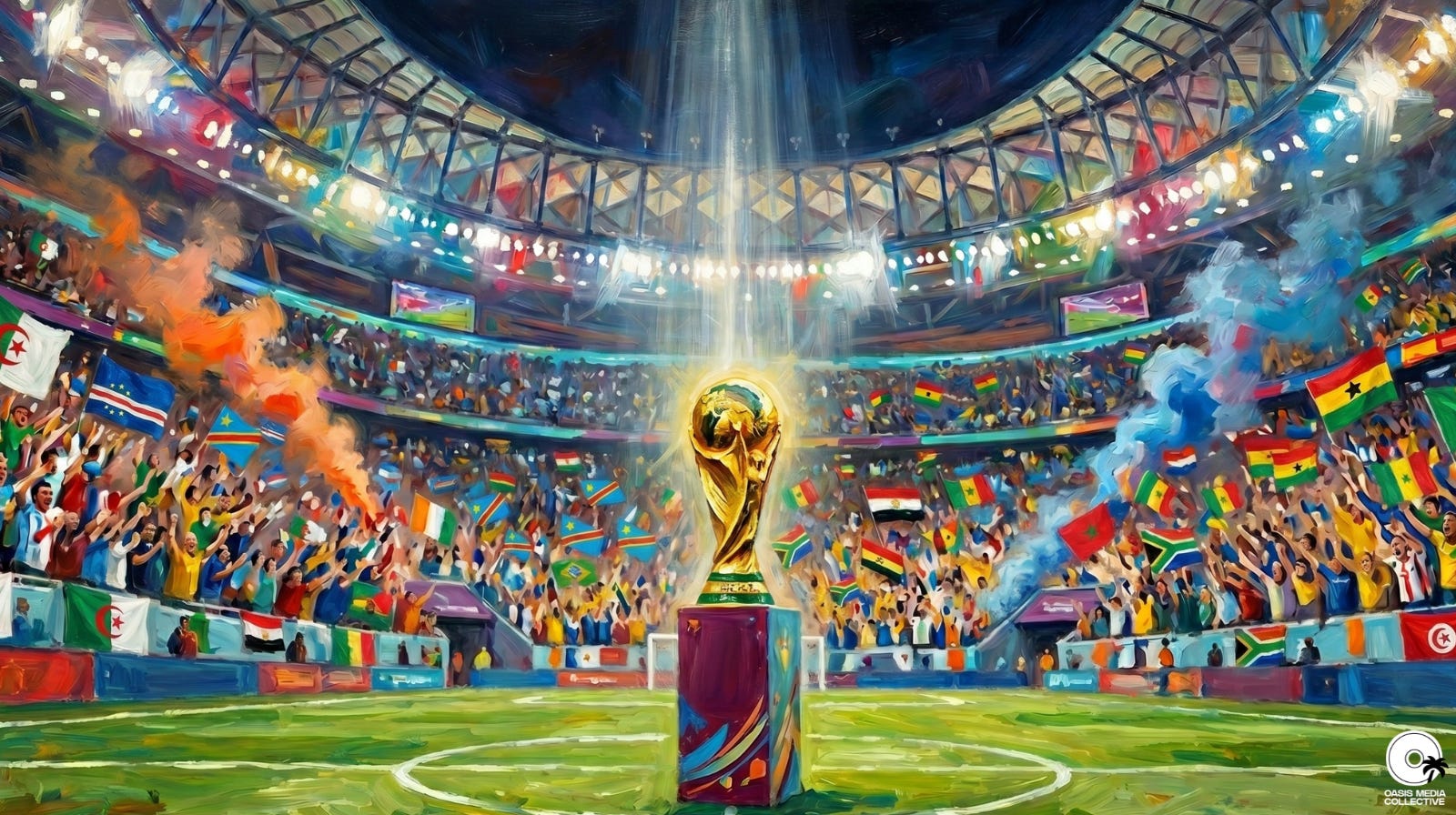
The upcoming 2026 World Cup will mark a historic first for the African continent. 10 countries—Algeria, Cabo Verde, Democratic Republic of the Congo, Côte d’Ivoire (Ivory Coast), Egypt, Ghana, Morocco, Senegal, South Africa, and Tunisia—will be making their way to North America to participate in the tournament, the largest African contingent in the tournament’s history.
Eyes everywhere are focused on the continent. While no African country has ever won a World Cup, Morocco made history in the 2022 edition when it reached the semifinals and finished in fourth place, a continental first. Morocco’s achievement was the culmination of nearly 90 years of African football slowly and persistently forcing its way onto the world stage.
This piece traces that journey through numbers, records, and moments.
From the Margins
Africa’s first appearance at a World Cup came in 1934, when Egypt became the continent’s sole representative.
What many saw as the start of an exciting new chapter turned out to be short-lived. The Confederation of African Football (CAF) boycotted the 1966 World Cup entirely after FIFA refused to guarantee Africa a dedicated qualifying spot; in a protest that was shaped by politics as much as football, the move cost African countries a World Cup appearance, the next of which wouldn’t be until 1970, in which FIFA guaranteed a spot for the continent that was eventually filled by Morocco, the Kingdom’s first appearance in the tournament.
It wouldn’t be until 1982 when two African teams regularly appeared at the same tournament. If the Hungry 30s was Africa’s rise, the Roaring 80s was the continent’s consolidation in the tournament, showcasing its talent on the global stage.
Countries such as Cameroon and Nigeria built reputations as formidable squads, while Morocco defied expectations in 1986 when it came out as the victor in a group with England, Poland, and Portugal.
Italia 90 served to be the turning point for the continent in the World Cup. Roger Milla, a former Cameroon player, was lured out of retirement at age 38 to the tournament, becoming a World Cup icon overnight. His four goals, iconic corner-flag celebrations, and Cameroon’s run to the quarterfinals, advancing past the likes of Argentina and Colombia, became a defining image of African football announcing itself to the world.
The Numbers Behind the Runs
While the early decades were defined by heavy group-stage exits, from 1998 onward, a tournament which saw five African participants, the continent’s collective win rate climbed steadily.
The 2002 World Cup stands as a high-water mark for continental performance: Senegal beat defending champion France in the opening match and eventually trailblazing to the quarter finals.
The 2022 tournament in Qatar began slowly for Africa. Four of the five participants—Cameroon, Ghana, Senegal, and Tunisia—were eliminated in the group stage. But Morocco’s run rewrote the continent’s story entirely. They kept clean sheets against Belgium, ended Spain on penalties, and beat a Cristiano Ronaldo-led Portugal to become the first African nation to reach the semifinals.
Their fourth-place finish put pressure on FIFA’s allocation decisions. For 2026, the result: 9 guaranteed African berths (up from 5), with a potential tenth through a play-off.
From the Past to the Future
The numbers tell a continental underdog story. From Egypt’s solitary debut in 1934, through the 1966 boycott, through Cameroon’s corner-flag celebrations and Ghana’s heartbreaking penalty miss in 2010, to Morocco’s extraordinary 2022 semifinal run–African football has earned its growing place on the world stage.
With ten now participating, the question isn’t whether African teams belong at the World Cup nor will it be if they perform well. The real question is whether one of them will finally win it.
This reporting may be cited with attribution to Oasis Media Collective. For licensing, republication, or extended use, contact here.